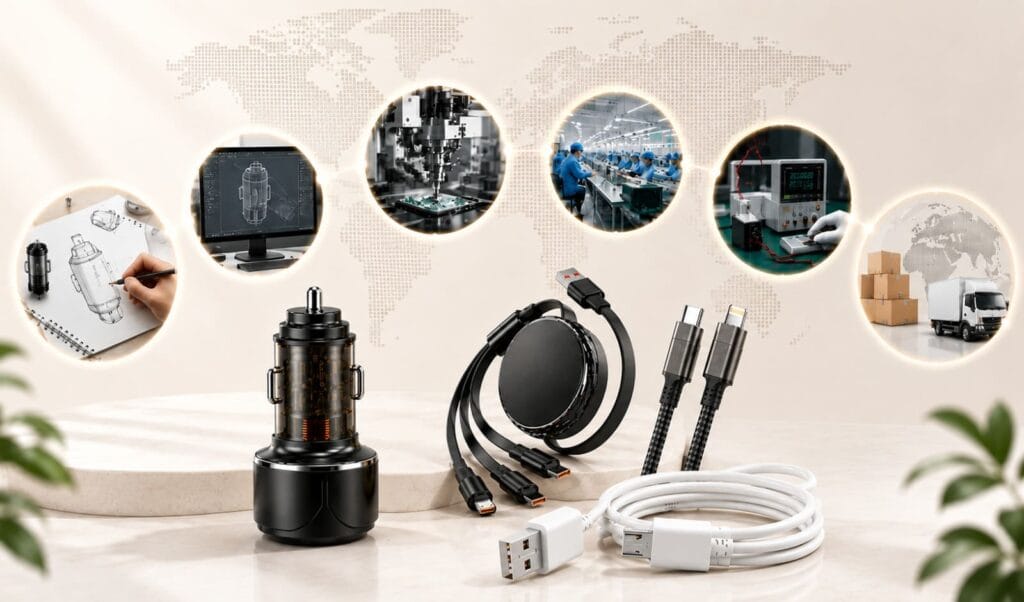
The OEM mobile accessories industry has experienced remarkable growth over the past decade, driven by increasing smartphone adoption and rising consumer demand for high-quality accessories. Products such as wireless earbuds, Bluetooth speakers, neckbands, headphones, chargers, charging cables, mobile stands, and power accessories have become essential for everyday life. As competition continues to grow, many businesses are choosing OEM (Original Equipment Manufacturer) services to launch their own branded mobile accessories without investing in manufacturing facilities.
OEM manufacturing allows businesses to create customized products under their own brand while relying on an experienced manufacturer for product development, production, quality testing, packaging, and logistics. This approach helps businesses reduce investment costs, accelerate product launches, and maintain consistent product quality.
In this guide, we’ll walk through the complete OEM mobile accessories manufacturing process, from initial product design to final delivery.
What Is OEM Mobile Accessories Manufacturing?
OEM (Original Equipment Manufacturer) manufacturing is a process in which a manufacturer produces mobile accessories according to a client’s specifications while allowing the products to be sold under the client’s brand name. The manufacturer manages the complete production cycle, including sourcing raw materials, manufacturing, assembly, testing, packaging, and shipping.
OEM manufacturing is widely used by retailers, distributors, wholesalers, importers, exporters, startups, e-commerce sellers, and established brands looking to expand their product portfolio with minimal production risk.
Step 1: Requirement Analysis and Product Planning
Every successful OEM project begins with understanding the client’s business requirements. During this stage, the manufacturer works closely with the client to determine product specifications, target customers, budget, expected order quantity, and branding requirements.
The discussion typically covers product type, technical specifications, features, colors, materials, logo placement, packaging design, certification requirements, and delivery timelines.
Clear planning at this stage ensures that the manufacturing process proceeds smoothly without unnecessary revisions.
Step 2: Product Design and Development
Once the project requirements are finalized, the design and development process begins.
Industrial designers and engineers create product concepts based on the client’s requirements and current market trends. CAD (Computer-Aided Design) software is used to develop detailed product models, internal structures, and component layouts.
The design phase focuses on creating products that combine attractive aesthetics with durability, comfort, functionality, and efficient manufacturing.
For products such as wireless earbuds, headphones, speakers, chargers, and mobile stands, every detail is carefully engineered to ensure both appearance and performance meet market expectations.
Step 3: Prototype Development
After completing the design, the manufacturer develops product prototypes.
Prototypes allow both the manufacturer and client to evaluate the product before mass production begins. During this phase, engineers test product dimensions, functionality, ergonomics, charging performance, sound quality, wireless connectivity, durability, and compatibility.
Clients can review the prototype and request adjustments before final approval. This stage helps eliminate potential manufacturing issues and ensures the final product matches expectations.
Step 4: Component Sourcing
Following prototype approval, the manufacturer begins sourcing high-quality components from trusted suppliers.
Depending on the product, components may include printed circuit boards (PCBs), Bluetooth chips, batteries, charging ICs, USB connectors, Type-C connectors, speaker drivers, microphones, plastic housings, silicone parts, cables, magnets, electronic switches, and packaging materials.
Reliable component sourcing plays a critical role in ensuring long-term product quality and performance.
Step 5: Tooling and Mold Development
For customized products, manufacturers develop production molds using precision engineering techniques.
Injection molds are created for plastic housings, charging adapters, speaker enclosures, earbud cases, cable connectors, and other product components.
High-quality molds ensure accurate dimensions, smooth finishes, and consistent production quality across thousands of units.
Although tooling requires an initial investment, it significantly improves manufacturing efficiency for large production volumes.
Step 6: Mass Production
Once tooling and components are ready, mass production begins.
Automated production lines manufacture product housings, electronic assemblies, charging modules, speaker systems, and cable components. Skilled technicians assemble the products according to predefined quality standards.
Production processes vary depending on the product but generally include PCB assembly, soldering, plastic injection molding, ultrasonic welding, cable assembly, battery installation, firmware programming, and final assembly.
Modern manufacturing facilities combine automation with skilled manual inspection to achieve high production efficiency while maintaining product quality.
Step 7: Quality Control and Testing
Quality control is one of the most important stages of OEM manufacturing.
Each product undergoes multiple inspections throughout the manufacturing process.
Common quality tests include:
- Visual Inspection
- PCB Testing
- Bluetooth Connectivity Testing
- Battery Performance Testing
- Charging Efficiency Testing
- Voltage and Current Testing
- Audio Quality Testing
- Frequency Response Testing
- Drop Testing
- Button Life Testing
- Connector Durability Testing
- Cable Bending Test
- Temperature Testing
- Aging Test
- Short Circuit Protection Test
- Overcurrent Protection Test
- Overvoltage Protection Test
Products that fail quality inspections are rejected before packaging.
Step 8: Logo Printing and Branding
After passing quality inspections, products move to the branding stage.
OEM manufacturers provide custom logo printing using techniques such as laser engraving, UV printing, silk screen printing, pad printing, and embossing.
Clients can customize:
- Product Logo
- Brand Name
- Color Scheme
- Packaging Design
- User Manual
- Warranty Card
- Barcode Label
- QR Code
- Product Stickers
Professional branding helps businesses establish a strong identity and improve customer recognition.
Step 9: Packaging
Packaging is an important part of the customer experience.
OEM manufacturers design attractive retail packaging that protects products during transportation while enhancing brand value.
Packaging options include:
- Premium Retail Boxes
- Eco-Friendly Packaging
- Magnetic Boxes
- Window Boxes
- Hanging Display Boxes
- Printed Cartons
- Customized Inserts
Each package is inspected to ensure proper labeling and product protection.
Step 10: Final Inspection
Before shipment, the manufacturer conducts a final inspection.
This includes verifying product appearance, functionality, accessories, packaging quality, labeling accuracy, and order quantity.
Random sampling inspections are also performed to maintain consistent quality across the production batch.
Only products that meet the required quality standards are approved for shipment.
Step 11: Shipping and Delivery
After final approval, products are carefully packed for transportation.
Manufacturers provide domestic and international shipping options based on customer requirements.
Orders are securely packed to minimize damage during transit and delivered according to agreed schedules.
Many OEM manufacturers also provide export documentation, customs support, and logistics coordination for international shipments.
Advantages of OEM Mobile Accessories Manufacturing
OEM manufacturing offers numerous advantages for businesses looking to build their own brand.
Businesses benefit from lower manufacturing costs, faster product development, professional engineering support, custom branding, high production capacity, strict quality control, flexible order quantities, reliable supply chains, and faster market entry.
By outsourcing manufacturing to experienced OEM partners, businesses can focus on marketing, customer service, and business growth while maintaining product quality.
Industries That Use OEM Manufacturing
OEM mobile accessories manufacturing serves a wide range of industries.
These include mobile accessory brands, wholesalers, distributors, retailers, e-commerce sellers, telecom companies, corporate gifting companies, importers, exporters, promotional product suppliers, and startups launching new consumer electronics brands.
Future of OEM Mobile Accessories Manufacturing
The OEM manufacturing industry continues to evolve with advancements in automation, artificial intelligence, smart manufacturing, robotics, sustainable materials, and environmentally friendly production processes.
Future products will increasingly feature fast charging technology, AI-powered devices, smart wearables, wireless charging, energy-efficient electronics, and eco-friendly packaging.
Manufacturers investing in innovation and quality will continue to lead the global mobile accessories market.
Conclusion
OEM mobile accessories manufacturing provides businesses with a reliable, scalable, and cost-effective solution for launching premium-quality products under their own brand. From initial product design and prototype development to component sourcing, mass production, quality testing, custom branding, packaging, and final delivery, every stage plays a vital role in creating products that meet customer expectations.
Choosing an experienced OEM manufacturing partner ensures consistent quality, faster production, and complete customization, enabling businesses to compete successfully in the rapidly growing mobile accessories industry.
Frequently Asked Questions (FAQs)
1. What is OEM mobile accessories manufacturing?
OEM manufacturing involves producing mobile accessories according to a client’s specifications while allowing products to be sold under the client’s own brand.
2. Which products can be manufactured through OEM services?
Wireless earbuds, Bluetooth speakers, headphones, neckbands, chargers, charging cables, power adapters, mobile stands, car chargers, and many other mobile accessories.
3. Can I customize my products with my own logo?
Yes. OEM manufacturers provide custom logo printing, private label packaging, custom colors, branding, and packaging design.
4. How is product quality maintained?
Manufacturers perform multiple inspections and tests, including functionality testing, durability testing, charging tests, audio testing, safety testing, and final quality inspections before shipment.
5. Who should choose OEM manufacturing?
OEM manufacturing is ideal for retailers, wholesalers, distributors, startups, importers, exporters, e-commerce sellers, and businesses planning to launch their own mobile accessories brand.
Planning Your Own Mobile Accessories Brand
Get an OEM manufacturing quote based on your product, quantity, specifications, branding and packaging requirements.Discuss your requirements for earbuds, neckbands, Bluetooth speakers, chargers, cables, headphones, car chargers and mobile stands.