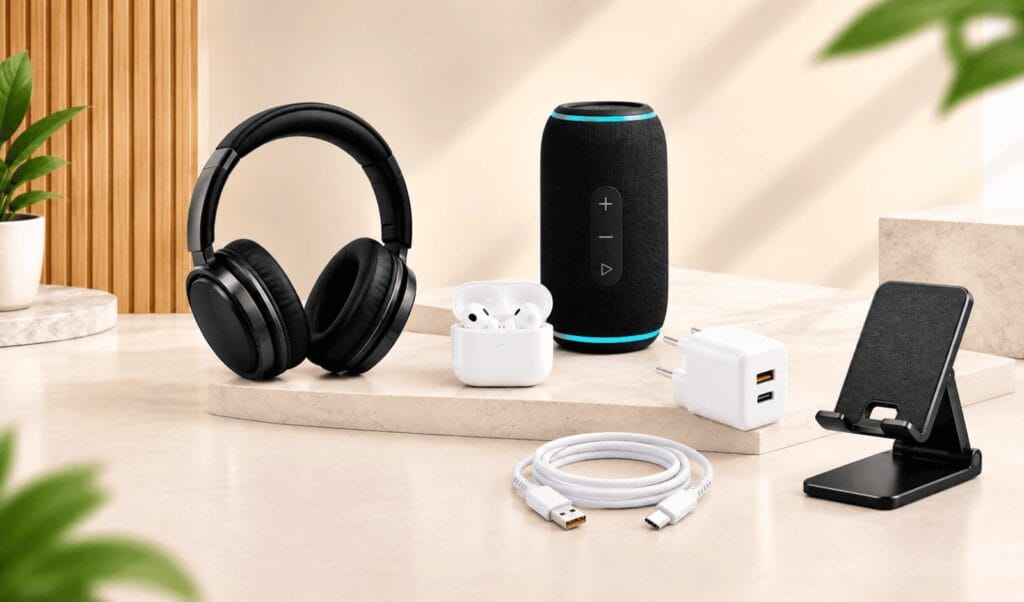
OEM Mobile Accessories: How to Select Products for Your Brand – Launching your own mobile accessories brand is an exciting opportunity, but selecting the right products is one of the most important decisions you will make. The mobile accessories market includes a wide range of products such as wireless earbuds, Bluetooth speakers, neckbands, mobile chargers, charging cables, car chargers, stands, wired earphones, and other everyday tech accessories.
When working with an OEM mobile accessories manufacturer, you can customize products according to your brand requirements, packaging, specifications, colors, and target market. However, choosing products only because they are popular is not enough. You need to consider product demand, quality, pricing, features, competition, target customers, and long-term business potential.
This guide explains how to select the right OEM mobile accessories for your brand and build a product range that can support your business growth.
What Are OEM Mobile Accessories?
OEM stands for Original Equipment Manufacturer. In OEM manufacturing, a manufacturer produces mobile accessories according to the requirements of another brand.
For example, a business can work with an OEM manufacturer to source wireless earbuds with its own:
Brand logo
Product specifications
Colors
Packaging
User manuals
Product design requirements
Retail box
Accessories and included components
Instead of manufacturing every component yourself, you can partner with an experienced OEM manufacturer and focus on branding, marketing, distribution, and sales.
Why Product Selection Matters for Your Brand
The products you select directly affect your brand’s reputation, customer satisfaction, margins, and repeat purchases.
Choosing the wrong products can lead to:
Low sales
High return rates
Customer complaints
Excess inventory
Poor reviews
Reduced profit margins
Difficulty competing in the market
On the other hand, selecting products based on your target customers and market demand can help you create a stronger and more focused product portfolio.
1. Understand Your Target Customers
Before selecting any OEM product, identify who you want to sell to.
Different customers have different requirements. For example:
Students and young consumers may prefer affordable earbuds, neckbands, charging cables, and compact speakers.
Working professionals may look for reliable wireless earbuds, fast chargers, power accessories, and products suitable for calls and travel.
Car users may be interested in car chargers, mobile holders, and dashboard or air-vent phone stands.
Retail customers may prefer affordable products with attractive packaging and commonly requested features.
Understanding your target customer helps you select products that have a clear purpose in your market.
2. Research Market Demand
Market demand should be one of the first factors you consider.
Before placing a bulk OEM order, research which accessories customers are actively purchasing. Look at:
Search trends
Online marketplaces
Retail stores
Competitor product ranges
Customer reviews
Social media trends
Frequently requested features
For example, if your target market has strong demand for wireless audio products, you could consider starting with OEM wireless earbuds, Bluetooth speakers, or Bluetooth neckbands.
The goal is not to sell every type of accessory. The goal is to select products that have a realistic customer base.
3. Choose Products That Match Your Brand Position
Your products should match the image you want your brand to create.
If you want to build an affordable accessories brand, you may focus on:
Entry-level earbuds
Charging cables
Basic chargers
Wired earphones
Affordable mobile stands
If you want to create a premium technology brand, your product range may include:
Premium wireless earbuds
High-quality Bluetooth speakers
Fast chargers
Premium charging cables
Advanced audio accessories
A consistent product range makes it easier for customers to understand what your brand represents.
4. Start With a Focused Product Range
One common mistake new brands make is launching too many products at once.
Instead, consider starting with a small selection of products and gradually expanding your range.
For example, an initial OEM product portfolio could include:
Wireless Earbuds
Bluetooth Neckband
Bluetooth Speaker
Mobile Charger
Charging Cable
Car Charger
Mobile Stand
Once you understand which products perform well, you can introduce additional models and variations.
A focused range can also make inventory management, marketing, packaging, and quality control easier.
5. Evaluate Product Quality Carefully
Price should not be the only consideration when selecting an OEM manufacturer or product.
A low-cost product with poor quality can create customer complaints and damage your brand reputation.
Evaluate factors such as:
Material quality
Build quality
Battery performance
Sound quality
Charging performance
Connector quality
Durability
Product finishing
Packaging quality
Safety and compliance requirements
Always request samples before committing to a large production order.
Testing samples gives you an opportunity to identify potential issues before the products reach your customers.
6. Compare Product Features
Different models can have significantly different features.
For wireless earbuds, for example, you may compare:
Bluetooth version
Battery capacity
Total playtime
Charging case capacity
Microphone quality
ENC or noise-reduction features
Charging interface
Touch controls
Water resistance
Fast charging
For Bluetooth speakers, you might evaluate:
Output power
Battery capacity
Bluetooth connectivity
Playtime
Charging interface
RGB lighting
Microphone functionality
Portability
Water resistance
Choose features based on what your customers actually need rather than simply adding features to increase the specification list.
7. Consider Your Target Price
Before selecting a product, determine the price range at which you want to sell it.
Your target selling price should account for:
Product Cost + Packaging + Shipping + Taxes/Duties + Marketing + Distribution + Retail Margin + Other Business Costs
For example, if you want to sell an accessory in an affordable price segment, selecting an expensive OEM configuration may make it difficult to maintain your desired retail price.
Discuss your target price with the manufacturer and determine which specifications can provide the right balance between quality and cost.
8. Check MOQ Requirements
MOQ means Minimum Order Quantity.
OEM manufacturers may have different MOQ requirements depending on:
Product type
Customization level
Packaging
Logo printing
Color customization
Product design
Production requirements
If you are starting a new brand, it is important to understand the MOQ before finalizing a product.
Ask the manufacturer:
What is the minimum order quantity?
Is the MOQ different for customized packaging?
Is logo printing included?
Can different colors be combined?
Can different models be ordered together?
What is the sample cost?
Understanding MOQ requirements helps you plan your initial investment and inventory.
9. Look at Customization Options
OEM manufacturing gives brands the opportunity to customize products and packaging.
Depending on the manufacturer, customization may include:
Brand logo
Product color
Packaging design
Retail box
User manual
Product labeling
Accessories
Product specifications
Cable length
Button configuration
Surface finish
However, customization requirements can affect production cost and MOQ.
Before placing an order, clearly define which elements need customization.
10. Pay Attention to Packaging
Packaging is an important part of your brand identity.
A well-designed package can make a product look more professional and help create consistency across your product range.
Your packaging should clearly communicate:
Brand name
Product name
Key features
Specifications
Compatibility information
Usage instructions
Warranty information, where applicable
Required regulatory or product information
The packaging should also provide adequate protection during transportation and storage.
11. Check Compatibility
Mobile accessories need to work reliably with the devices customers use.
Before selecting a product, consider compatibility with:
Android smartphones
iPhones
Tablets
Laptops
Cars
USB-C devices
Other commonly used electronic devices
For charging products especially, compatibility and technical specifications should be carefully evaluated.
Clear compatibility information can reduce customer confusion and product returns.
12. Consider Product Safety and Compliance
Safety and regulatory requirements should be part of your OEM selection process.
Depending on the product and market, different certifications, testing, labeling, and compliance requirements may apply.
For products such as chargers, cables, batteries, earbuds, and Bluetooth devices, ask the manufacturer about relevant testing and compliance documentation.
Do not rely only on a logo printed on the product or packaging. Request appropriate documentation and verify whether it applies to the specific product model and market.
13. Compare Multiple OEM Manufacturers
Do not select a manufacturer based only on the lowest quotation.
Compare manufacturers based on:
| Factor | What to Check |
|---|---|
| Product Quality | Materials, performance and durability |
| MOQ | Minimum production quantity |
| Pricing | Product and customization costs |
| Customization | Logo, packaging and specifications |
| Samples | Availability and testing |
| Production Time | Expected manufacturing timeline |
| Communication | Response and support |
| Quality Control | Inspection and testing process |
| Compliance | Relevant documentation |
| After-Sales Support | Warranty and issue handling |
A manufacturer that communicates clearly and maintains consistent quality can be more valuable than one offering only a lower initial price.
14. Test Samples Before Bulk Production
Never skip sample testing when developing a new OEM product.
Test the product under realistic usage conditions.
For example, for wireless earbuds, test:
Sound quality
Calling performance
Bluetooth connection
Battery life
Charging case
Touch controls
Microphone
Comfort
Charging reliability
For chargers and cables, test:
Charging speed
Connector durability
Compatibility
Heat management
Cable strength
Long-term performance
Document any changes you want before approving mass production.
15. Calculate Your Expected Profit Margin
Product selection should also make business sense financially.
Consider the complete landed cost instead of looking only at the factory price.
Your calculation should include:
OEM Product Cost + Custom Packaging + Transportation + Taxes/Duties + Warehousing + Marketing + Distribution Costs
Then compare your expected selling price with the total cost.
This helps you identify products that can support your desired business margins.
16. Think About Repeat Purchases
Some mobile accessories have natural replacement or upgrade cycles.
Charging cables, chargers, earbuds, and other frequently used accessories may provide opportunities for repeat purchases when customers need replacements or upgrades.
Consider whether a product can create repeat business through:
Replacement purchases
New models
Different colors
Upgraded versions
Product bundles
Complementary accessories
Building a product ecosystem can help customers purchase multiple products from the same brand.
17. Build a Complementary Product Portfolio
Instead of selecting completely unrelated products, consider products that naturally work together.
For example:
Wireless Earbuds + Bluetooth Speaker + Neckband
or
Mobile Charger + Charging Cable + Car Charger
or
Mobile Stand + Car Charger + Charging Cable
A complementary product portfolio allows you to create bundles and cross-selling opportunities.
For example, a customer purchasing a mobile charger may also need a charging cable, while a customer purchasing a car charger may be interested in a mobile holder.
18. Consider Competition
Research competing brands before finalizing your product.
Compare:
Price
Features
Design
Packaging
Warranty
Customer reviews
Product positioning
Availability
The objective is not necessarily to copy competitors. Instead, identify opportunities to differentiate your product.
Your brand could differentiate through:
Better packaging
Better product design
Useful features
Better customer support
Reliable quality
Attractive pricing
Strong warranty policies
19. Plan Your Product Roadmap
Your first product launch does not have to contain your entire product catalog.
Create a product roadmap.
Phase 1 – Launch
Start with a small number of high-demand products.
Phase 2 – Expansion
Add additional models, colors, and price segments based on customer response.
Phase 3 – Product Development
Introduce customized products, improved specifications, or exclusive designs.
This approach allows your brand to grow its product range based on real market feedback.
Common Mistakes to Avoid When Selecting OEM Products
Choosing Only Based on Price
The cheapest product may not provide the quality your brand needs.
Ordering Large Quantities Without Testing
Always test samples before approving mass production.
Selecting Too Many Products
A large product range can create unnecessary inventory and management challenges.
Ignoring Packaging
Packaging contributes to the customer’s first impression of your brand.
Not Checking Compliance
Make sure relevant regulatory and safety requirements are addressed for your product and target market.
Copying Competitors Completely
Your brand should have its own positioning and product strategy.
Not Calculating Total Costs
Factory pricing is only one part of the total cost of bringing a product to market.
How to Select the Right OEM Mobile Accessories: A Simple Checklist
Before finalizing any product, ask yourself:
Who is my target customer?
Is there sufficient market demand?
Does this product fit my brand?
What is my target selling price?
What is the total landed cost?
What is the MOQ?
Can the product be customized?
Have I tested a sample?
Is the product reliable and durable?
What compliance documentation is required?
How does it compare with competing products?
Can I maintain consistent quality?
Does this product complement my existing range?
Can the manufacturer support future orders?
If you can answer these questions clearly, you will have a stronger foundation for selecting your OEM product range.
Final Thoughts
Selecting the right products is one of the most important steps when building a mobile accessories brand. The best product strategy is not simply about finding the cheapest products or following every market trend. It is about understanding your customers, selecting appropriate features, maintaining quality, controlling costs, and working with an OEM manufacturer that can consistently meet your requirements.
Start with a focused range, test products carefully, understand your target market, and gradually expand based on customer demand and business performance.
With the right OEM mobile accessories manufacturer, you can develop products that match your brand identity, target price range, quality expectations, and long-term business goals.
Whether you are planning to launch wireless earbuds, Bluetooth speakers, neckbands, mobile chargers, charging cables, car chargers, mobile stands, or other accessories, a structured product-selection process can help you build a more consistent and scalable product portfolio.
Planning Your Own Mobile Accessories Brand
Get an OEM manufacturing quote based on your product, quantity, specifications, branding and packaging requirements.Discuss your requirements for earbuds, neckbands, Bluetooth speakers, chargers, cables, headphones, car chargers and mobile stands.