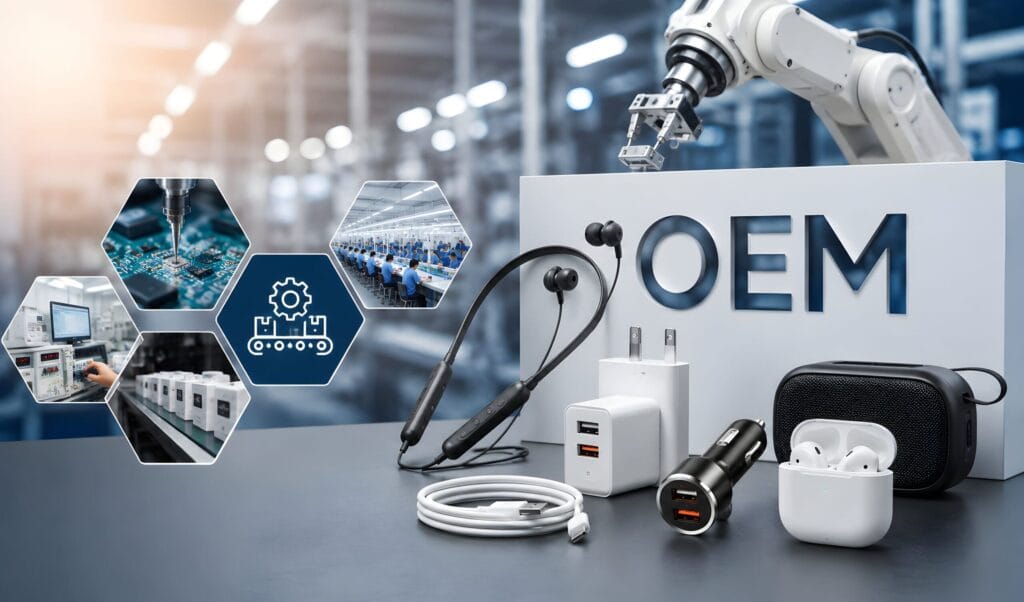
OEM manufacturing has become a popular business model for companies that want to launch products under their own brand without investing in a complete manufacturing facility. From mobile chargers and charging cables to wireless earbuds, speakers, neckbands, and other electronics, businesses can work with an OEM manufacturer to develop and produce products according to their requirements.
But what exactly is OEM manufacturing? How does the OEM process work? What are its benefits, and how can a business choose the right OEM manufacturer?
In this complete guide, we will explain what OEM manufacturing is, how it works, its benefits, the manufacturing process, OEM examples, OEM vs ODM, MOQ, costs, and important factors to consider before placing an order.
What Is OEM Manufacturing?
OEM stands for Original Equipment Manufacturer.
OEM manufacturing is a process in which a manufacturer produces products according to the requirements, specifications, or designs provided by another company. The finished products can then be sold by that company under its own brand name.
Instead of building its own factory, purchasing production machinery, hiring a manufacturing team, and managing the entire production process, a business can partner with an experienced OEM manufacturer.
For example, a company wants to launch its own branded 25W mobile charger. Instead of manufacturing the charger itself, the company can approach an OEM manufacturer and specify:
- Required power output
- Product design
- Product color
- Logo placement
- Packaging requirements
- Quantity
- Technical specifications
The OEM manufacturer then produces the charger according to the agreed requirements.
This allows the company to focus on branding, marketing, sales, and distribution while the manufacturer handles production.
How Does OEM Manufacturing Work?
The OEM manufacturing process generally involves several important stages. A professional manufacturer works closely with the buyer to understand the product requirements and convert them into a finished product.
1. Requirement Analysis
The process begins with understanding the buyer’s requirements.
The manufacturer discusses important details such as:
- Product category
- Product specifications
- Features
- Quantity
- Target market
- Budget
- Branding
- Packaging
- Delivery requirements
Clear communication at this stage helps avoid problems during production.
2. Product Selection
The buyer can either select an existing product from the manufacturer’s product range or provide specific product requirements.
For mobile accessories, common OEM products include:
- Mobile chargers
- Fast chargers
- USB chargers
- Car chargers
- Charging cables
- Multi-charging cables
- Wireless earbuds
- TWS earbuds
- Bluetooth speakers
- Neckbands
- Wired earphones
- Mobile stands
An existing product can often be customized with branding and packaging according to the buyer’s requirements.
3. Product Customization
Depending on the product and manufacturer’s capabilities, different levels of customization may be available.
Customization can include:
- Brand logo
- Product color
- Product finish
- Packaging
- Labels
- User manuals
- Product specifications
- Accessories
- Design modifications
Simple customization may involve only logo printing and packaging, while advanced OEM projects can involve changes to the product itself.
4. Sample Development
Before starting bulk production, a sample is usually reviewed and approved.
The buyer can check:
- Product quality
- Appearance
- Logo placement
- Product performance
- Materials
- Packaging
- Features
- Overall finishing
If changes are required, they can be discussed before mass production begins.
Sample approval is important because it reduces the risk of receiving a large quantity of products that do not meet the expected requirements.
5. Branding and Packaging
Once the product specifications are finalized, branding and packaging requirements are confirmed.
OEM manufacturers may provide options such as:
- Custom logo printing
- Custom product labels
- Retail boxes
- Printed packaging
- User manuals
- Warranty cards
- Barcode labels
- Stickers
Custom packaging helps businesses create a professional and recognizable brand identity.
6. Quality Testing
Quality control is an important part of OEM manufacturing.
Depending on the product, testing may include:
- Performance testing
- Electrical testing
- Charging testing
- Battery testing
- Audio testing
- Connectivity testing
- Durability checks
- Material inspection
- Packaging inspection
For electronic products such as chargers and charging cables, appropriate electrical and safety testing is especially important.
7. Bulk Production
After sample approval, the manufacturer starts bulk production.
The production process may include:
- Raw material and component sourcing
- Component assembly
- Product manufacturing
- Logo printing
- Product testing
- Quality inspection
- Packaging
- Final inspection
Production time depends on factors such as product type, quantity, customization, component availability, and production capacity.
8. Final Inspection and Delivery
Before dispatch, finished products are inspected against the agreed specifications.
After the final quality check, the products are packed and delivered to the buyer.
The buyer can then distribute the products through:
- Online marketplaces
- E-commerce websites
- Retail stores
- Distributors
- Wholesalers
- Corporate sales
- Its own website
OEM Manufacturing Process at a Glance
The complete OEM process can be summarized as:
Requirement Analysis → Product Selection → Customization → Sample Development → Approval → Branding & Packaging → Quality Testing → Bulk Production → Final Inspection → Delivery
Following a structured process helps businesses manage product quality, branding, timelines, and production requirements more effectively.
Benefits of OEM Manufacturing
OEM manufacturing offers several advantages to startups, retailers, distributors, established brands, and companies entering new product categories.
1. Build Your Own Brand
One of the biggest advantages of OEM manufacturing is the ability to sell products under your own brand.
Businesses can customize:
- Logo
- Product branding
- Packaging
- Product appearance
- Labels
This allows companies to build their own identity instead of selling completely generic products.
2. Lower Initial Manufacturing Investment
Setting up a manufacturing facility requires substantial investment in:
- Factory space
- Machinery
- Production equipment
- Raw materials
- Employees
- Testing equipment
- Inventory
- Manufacturing management
OEM manufacturing reduces the need for a business to make these investments from the beginning.
3. Access to Manufacturing Expertise
Experienced OEM manufacturers already have knowledge of product manufacturing, assembly, sourcing, testing, quality control, and packaging.
Businesses can use this expertise without developing an entire manufacturing operation themselves.
4. Faster Product Launch
Working with an established manufacturer can help businesses launch products faster compared with building a manufacturing facility from scratch.
This can be especially useful in competitive markets where businesses need to respond quickly to customer demand.
5. Product Customization
OEM manufacturing allows businesses to create products that match their brand requirements.
Depending on the manufacturer, customization can include:
- Logo
- Colors
- Packaging
- Product specifications
- Materials
- Product design
- Accessories
6. Scalable Production
OEM manufacturing can support businesses as their product demand increases.
A company can start with an initial bulk order and increase production as sales grow, subject to the manufacturer’s MOQ and production capacity.
7. Focus on Marketing and Sales
When production is handled by an OEM manufacturer, businesses can focus their resources on:
- Marketing
- Branding
- Sales
- Distribution
- Customer service
- Product promotion
This makes OEM manufacturing an attractive option for companies that want to build a product brand without managing factory operations.
OEM Manufacturing Examples
OEM manufacturing is used across many industries.
Mobile Accessories
Mobile accessories are a common example of OEM and private-label manufacturing.
Businesses can source products such as:
- Mobile chargers
- Fast charging adapters
- USB chargers
- Car chargers
- Charging cables
- PD charging cables
- Multi-charging cables
- Wireless earbuds
- Bluetooth speakers
- Neckbands
- Wired earphones
- Mobile stands
These products can be customized with a company’s branding and packaging.
Consumer Electronics
OEM manufacturing is also widely used for:
- Audio devices
- Electronic accessories
- Computer accessories
- Smart devices
- Power accessories
Automotive Components
Automotive businesses may work with specialized OEM manufacturers to produce components according to technical specifications and quality requirements.
Industrial Components
OEM manufacturing is also used for industrial products and components where businesses require specific designs, materials, dimensions, or performance requirements.
OEM vs ODM: What Is the Difference?
OEM and ODM are related manufacturing models, but they are not exactly the same.
OEM (Original Equipment Manufacturer) generally involves producing a product according to the buyer’s agreed requirements, specifications, or design.
ODM (Original Design Manufacturer) generally involves a manufacturer providing an existing product design that a business can brand or customize.
OEM
- Buyer provides requirements or specifications
- Manufacturer produces the product
- Product can be customized
- Branding can be added
- Suitable for businesses requiring specific product requirements
ODM
- Manufacturer may already have the product design
- Buyer selects an existing product
- Branding and certain customization can be added
- Can be suitable for faster product launches
In simple terms:
OEM = Manufacture according to your requirements
ODM = Customize and brand an existing manufacturer design
The exact scope of OEM and ODM services can vary between manufacturers, so businesses should clearly define design ownership, specifications, customization, and intellectual property before starting production.
What Is Private Label Manufacturing?
Private label manufacturing is closely related to OEM manufacturing.
In private-label manufacturing, a manufacturer produces a product that another business sells under its own brand name.
For example:
Manufacturer → Product Manufacturing → Your Logo → Custom Packaging → Your Brand → Customer
Private labeling is popular among startups, retailers, distributors, and businesses that want to create their own product lines without operating a factory.
What Is MOQ in OEM Manufacturing?
MOQ means Minimum Order Quantity.
It refers to the minimum number of units a manufacturer requires for a particular order.
MOQ can vary depending on:
- Product category
- Product specifications
- Customization
- Logo printing
- Packaging
- Product color
- Components
- Production setup
For example, custom packaging may require a higher MOQ because packaging materials have to be produced specifically for the brand.
Before placing an order, businesses should ask:
- What is the minimum order quantity?
- Is the MOQ different for custom packaging?
- Can different colors be combined?
- Is there a minimum quantity for logo printing?
- Can samples be ordered before bulk production?
How Much Does OEM Manufacturing Cost?
There is no fixed OEM manufacturing price because the cost depends on the product and project requirements.
Important factors include:
- Product type
- Product specifications
- Components
- Materials
- Quantity
- Customization
- Logo printing
- Packaging
- Testing
- Shipping
- Taxes and duties where applicable
Larger quantities may provide better per-unit economics because production and setup costs can be distributed across more units.
For an accurate quotation, businesses should provide complete product requirements and expected order quantity to the manufacturer.
How to Choose the Right OEM Manufacturer
Choosing the right manufacturing partner is essential for maintaining product quality and meeting customer expectations.
Check Manufacturing Experience
Look for a manufacturer with experience in the specific product category you want to manufacture.
Review Customization Options
Ask whether the manufacturer provides:
- Logo printing
- Custom packaging
- Product colors
- Product modifications
- Private labeling
Check Quality Control
Ask about the manufacturer’s quality inspection and testing process.
Confirm MOQ
Make sure the manufacturer’s MOQ matches your business requirements and budget.
Check Production Capacity
If you expect large orders, confirm that the manufacturer has sufficient production capacity.
Evaluate Samples
Always evaluate product samples before committing to large-scale production whenever possible.
Discuss Lead Times
Confirm estimated production and delivery timelines before placing the order.
Maintain Clear Communication
Product specifications, packaging requirements, quantities, pricing, quality standards, and delivery terms should be clearly documented.
Questions to Ask an OEM Manufacturer Before Placing an Order
Before starting an OEM project, ask the manufacturer:
- What is your MOQ?
- Can you manufacture products under my brand?
- Do you offer custom logo printing?
- Can you provide custom packaging?
- Can I approve a sample before bulk production?
- What quality testing do you perform?
- What is the estimated production time?
- What customization options are available?
- Can you handle large-volume orders?
- What are the payment and delivery terms?
- Can you provide relevant product specifications and test reports?
- What happens if the finished products do not meet the agreed specifications?
Getting these details clearly defined before production can help reduce misunderstandings and production risks.
Why Is OEM Manufacturing Good for Startups?
OEM manufacturing can be particularly useful for startups because it allows them to launch products without investing heavily in their own manufacturing infrastructure.
A startup can follow a simple process:
Choose Product → Customize → Add Branding → Approve Sample → Place Bulk Order → Market Product → Build Brand
Instead of spending resources on setting up a factory, the business can focus on developing its brand, finding customers, marketing its products, and expanding its distribution network.
OEM Manufacturing for Mobile Accessories
The mobile accessories industry provides many opportunities for OEM and private-label businesses.
A company can build its own product range with products such as:
Charging Products
- Fast charging adapters
- USB chargers
- PD chargers
- Car chargers
- Charging cables
- Multi-charging cables
Audio Products
- Wireless earbuds
- TWS earbuds
- Bluetooth speakers
- Neckbands
- Wired earphones
Mobile Accessories
- Mobile stands
- Phone holders
- Other everyday mobile accessories
With the right OEM partner, businesses can develop a consistent product portfolio under a single brand identity.
Common OEM Manufacturing Mistakes to Avoid
Choosing Only on Price
The cheapest manufacturer may not always provide the best overall value.
Consider quality, manufacturing capabilities, testing, customization, communication, and reliability along with price.
Skipping the Sample
Never ignore the importance of product samples when possible. A sample allows you to evaluate the product before committing to bulk production.
Not Defining Specifications
Important product specifications should be clearly documented before production begins.
Ignoring Quality Control
Poor quality products can lead to customer complaints, returns, negative reviews, and damage to your brand reputation.
Not Confirming MOQ
Always confirm the minimum order quantity before finalizing the manufacturer.
Not Planning Packaging
Packaging should be finalized before production so that the product and branding remain consistent.
Not Discussing Delivery Timelines
Confirm production lead time and delivery schedules in advance to avoid delays.
Is OEM Manufacturing Right for Your Business?
OEM manufacturing can be a suitable option if you want to:
- Launch your own product brand
- Sell customized products
- Avoid setting up your own factory
- Reduce initial manufacturing investment
- Develop a wider product portfolio
- Order products in bulk
- Customize product branding and packaging
- Scale production as demand grows
However, success depends on selecting the right manufacturing partner and clearly defining your product requirements.
OEM Manufacturing with G4 Genius
G4 Genius provides OEM and private-label solutions for businesses looking to develop and source mobile accessories under their own brand.
The product range can include:
- Mobile chargers
- Fast chargers
- Car chargers
- Charging cables
- Multi-charging cables
- Wireless earbuds
- Bluetooth speakers
- Neckbands
- Wired earphones
- Mobile stands
From product selection and customization to branding, packaging, quality checks, and bulk manufacturing, an experienced OEM partner can help businesses simplify the process of launching their own mobile accessories brand.
If you are planning to start or expand a mobile accessories brand, you can discuss your product requirements, quantity, branding, packaging, and customization needs with an OEM manufacturer before starting production.
Frequently Asked Questions About OEM Manufacturing
What does OEM manufacturing mean?
OEM manufacturing means a manufacturer produces products according to a buyer’s agreed requirements, specifications, or design. The buyer can then sell the finished products under its own brand.
Is OEM the same as private label?
OEM and private label are closely related, but they are not always identical. Private labeling generally focuses on selling a manufacturer’s product under another company’s brand, while OEM manufacturing can involve production according to specific buyer requirements.
What is the difference between OEM and ODM?
OEM generally involves manufacturing according to buyer requirements, while ODM generally involves a manufacturer providing an existing product design that can be branded or customized.
Can startups use OEM manufacturing?
Yes. OEM manufacturing can help startups launch branded products without investing in their own factory and production infrastructure.
Can OEM products have my logo?
Yes. Many OEM manufacturers provide logo printing and branding services, depending on the product, customization requirements, and order quantity.
Can OEM manufacturers provide custom packaging?
Yes. Custom packaging such as boxes, labels, manuals, stickers, and other printed materials may be available depending on the manufacturer.
What is MOQ in OEM manufacturing?
MOQ stands for Minimum Order Quantity. It is the minimum number of units a manufacturer requires for a specific order.
Can OEM manufacturers make customized products?
Yes. Depending on the manufacturer’s capabilities, customization can range from logo printing and packaging to product specifications and design modifications.
Conclusion
OEM manufacturing provides businesses with an effective way to launch and sell products under their own brand without establishing a complete manufacturing facility.
The process typically involves requirement analysis, product selection, customization, sample development, approval, branding, quality testing, bulk production, final inspection, and delivery.
For businesses in the mobile accessories industry, OEM manufacturing can provide opportunities to develop branded products such as chargers, cables, earbuds, speakers, neckbands, earphones, and mobile stands.
The key to a successful OEM project is choosing a reliable manufacturer, defining product specifications clearly, approving samples, understanding MOQ and pricing, and maintaining proper quality control throughout the manufacturing process.
Whether you are a startup launching your first product or an established company expanding its product range, OEM manufacturing can help you build a branded product portfolio while reducing the need to manage your own manufacturing infrastructure.
Planning Your Own Mobile Accessories Brand
Get an OEM manufacturing quote based on your product, quantity, specifications, branding and packaging requirements.Discuss your requirements for earbuds, neckbands, Bluetooth speakers, chargers, cables, headphones, car chargers and mobile stands.