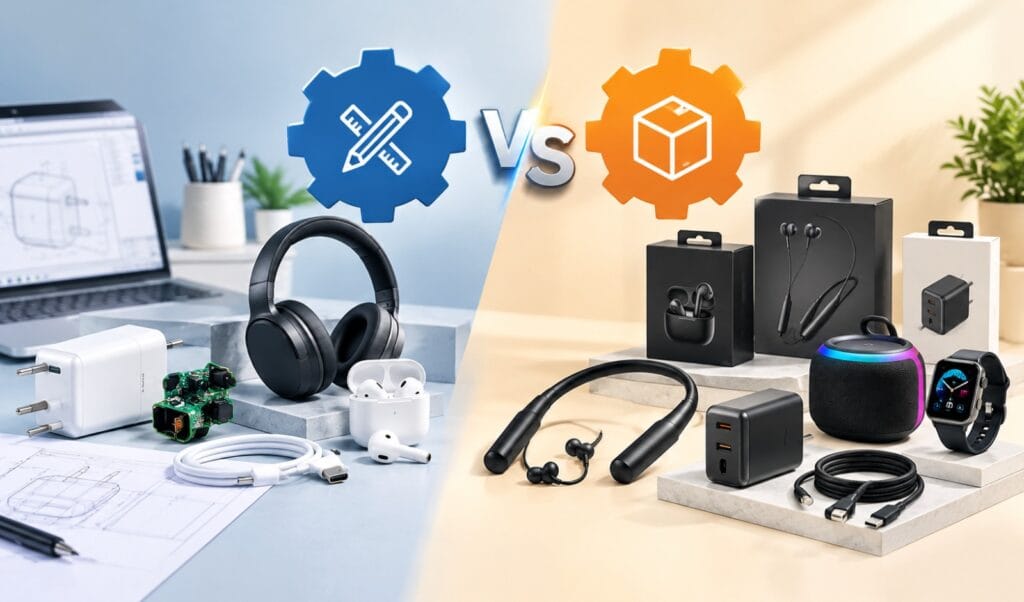
oem-vs-odm – If you are planning to launch your own mobile accessories brand, one of the most important decisions is choosing the right manufacturing model. Two common options are OEM (Original Equipment Manufacturer) and ODM (Original Design Manufacturer).
Both models can help businesses manufacture products under their own brand name, but they work differently. OEM manufacturing gives brands greater control over product specifications and customization, while ODM manufacturing allows businesses to use existing product designs with selected modifications and branding.
Understanding the difference between OEM and ODM can help you choose the right manufacturing strategy for your business, budget, timeline, and target market.
What Is OEM Manufacturing?
OEM stands for Original Equipment Manufacturer.
In an OEM manufacturing model, the brand provides the product requirements, specifications, design, features, or other technical instructions. The manufacturer then produces the product according to those requirements.
For example, a mobile accessories brand may want to launch a customized pair of wireless earbuds with:
- A specific design
- Custom battery capacity
- Particular Bluetooth specifications
- Custom sound tuning
- Specific charging technology
- Brand logo
- Customized colors
- Custom packaging
The OEM manufacturer develops or manufactures the product according to the brand’s requirements.
How OEM Manufacturing Works
A typical OEM process includes:
- Requirement analysis
- Product specification
- Design and engineering
- Prototype development
- Product testing
- Sample approval
- Mass production
- Quality inspection
- Custom branding and packaging
- Product delivery
OEM is particularly suitable for brands that want a differentiated product and greater control over the final specifications.
What Is ODM Manufacturing?
ODM stands for Original Design Manufacturer.
In an ODM model, the manufacturer already has an existing product design or product platform. The brand selects a suitable product and adds its own branding or makes certain modifications.
For example, an ODM manufacturer may already offer a wireless earbud model. A brand can select that model and customize elements such as:
- Logo
- Product color
- Packaging
- User manual
- Accessories
- Some product specifications
- Exterior design elements
This allows the brand to launch a product without developing everything from scratch.
How ODM Manufacturing Works
A typical ODM process includes:
- Select an existing product
- Discuss customization requirements
- Choose product specifications
- Add brand identity
- Approve samples
- Complete quality checks
- Begin bulk manufacturing
- Package and deliver the products
ODM can be a practical option for startups and businesses that want to enter the market quickly.
OEM vs ODM: Key Differences
Although both OEM and ODM can be used for private-label products, their manufacturing approaches are different.
| Factor | OEM | ODM |
|---|---|---|
| Product design | Customized according to brand requirements | Existing manufacturer design |
| Customization | High | Moderate |
| Product development | Usually more involved | Usually faster |
| Development cost | Generally higher | Generally lower |
| Launch time | Can be longer | Usually faster |
| Brand control | Higher | More limited |
| Product differentiation | High | Moderate |
| Suitable for | Established and product-focused brands | Startups and businesses seeking speed |
| Intellectual property considerations | Often more brand-specific | Design may originate with manufacturer |
The exact cost, MOQ, development time, and customization level depend on the manufacturer and product.
OEM vs ODM: Which Is Better?
There is no universal answer to whether OEM or ODM is better. The right choice depends on your business objectives.
Choose OEM If You Want More Customization
OEM may be the better option if your brand needs a product with unique specifications or a distinct design.
For example, if you are launching a premium wireless earbuds brand and want a specific combination of design, battery performance, controls, materials, and packaging, OEM manufacturing may provide greater flexibility.
Choose ODM If You Want a Faster Launch
ODM can be useful when your primary objective is to get a product to market quickly.
Instead of spending significant time developing a completely new product, you can select an existing model and customize it with your brand identity.
This can be particularly attractive for startups, distributors, retailers, and businesses testing a new product category.
OEM vs ODM for Mobile Accessories
OEM and ODM manufacturing are widely applicable to mobile accessories and consumer electronics.
Common products include:
Wireless Earbuds
Brands can manufacture customized TWS earbuds with different designs, battery capacities, controls, colors, and packaging options.
Wired Earphones
Businesses can select or develop earphone designs based on their target customers and price segment.
Neckbands
OEM and ODM neckband manufacturing can include customization of design, controls, colors, branding, and packaging.
Bluetooth Speakers
Brands can develop portable Bluetooth speakers with different form factors, battery capacities, controls, lighting, and branding options.
Mobile Chargers
OEM manufacturing can be used for customized wall chargers, fast chargers, and other charging solutions according to required specifications.
Charging Cables
Businesses can manufacture charging and data cables with different connector types, lengths, materials, colors, and branding requirements.
Mobile Stands
OEM and ODM models can also be used for mobile stands designed for desks, cars, travel, or other applications.
Benefits of OEM Manufacturing
OEM manufacturing provides several advantages for brands looking for product differentiation.
1. Higher Product Customization
Brands can specify product features, materials, design requirements, colors, packaging, and other elements.
2. Stronger Brand Differentiation
A customized product can help your brand stand apart from competitors selling similar generic products.
3. Greater Control
The brand can have more influence over product specifications and quality requirements.
4. Better Long-Term Product Strategy
OEM can be useful when a business wants to build a long-term product portfolio rather than simply resell an existing product.
5. Custom Branding and Packaging
OEM manufacturing can support private-label branding, customized packaging, logos, manuals, labels, and other brand elements.
Benefits of ODM Manufacturing
ODM manufacturing also provides important advantages.
1. Faster Product Launch
Because the basic product already exists, development can be faster than creating a completely new product.
2. Lower Development Requirements
Businesses may not need to invest as heavily in product development and engineering.
3. Easier Market Entry
ODM can make it easier for startups and new brands to enter the mobile accessories market.
4. Existing Product Experience
Manufacturers may already have experience producing the selected product, which can simplify the manufacturing process.
5. Private Label Opportunities
Businesses can sell existing product designs under their own brand through customized branding and packaging.
OEM vs ODM: Cost Comparison
Cost is one of the biggest factors businesses consider when choosing between OEM and ODM.
OEM products generally require more product development, engineering, prototyping, testing, and customization. As a result, the initial investment can be higher.
ODM products can have lower development requirements because the manufacturer already has an existing design or product platform.
However, the cheapest manufacturing model is not always the best choice.
A business should consider:
- Product development cost
- Unit manufacturing cost
- MOQ
- Tooling requirements
- Packaging cost
- Testing requirements
- Shipping and logistics
- Quality control
- Customization requirements
- Expected sales volume
Instead of comparing only the initial price, evaluate the total cost of bringing the product to market.
OEM vs ODM: Which Is Better for Startups?
For many startups, ODM can be an attractive starting point because it can reduce development complexity and help bring products to market faster.
For example, a startup launching its first wireless earbuds can select an existing ODM model, customize the branding and packaging, and test customer demand.
Once the brand gains market experience, it may move toward more customized OEM products.
However, startups with a strong product concept, sufficient budget, and clear differentiation strategy may prefer OEM from the beginning.
OEM vs ODM: Which Is Better for Established Brands?
Established brands may prefer OEM when product differentiation, customization, and long-term product development are important.
An established brand may want to control the product experience across:
- Industrial design
- Product specifications
- Performance
- Materials
- Packaging
- Branding
- Accessories
- Quality standards
In such cases, an OEM partnership can provide greater control over the final product.
What Should You Ask an OEM or ODM Manufacturer?
Before selecting a manufacturing partner, ask detailed questions about the manufacturing process.
Important questions include:
1. What is the MOQ?
Understand the minimum order quantity for the product and whether customization changes the MOQ.
2. What customization options are available?
Ask whether the manufacturer can customize product design, colors, materials, specifications, branding, and packaging.
3. Can you provide samples?
Always evaluate samples before committing to a large production order.
4. What quality testing is performed?
Ask about inspection procedures and product testing before shipment.
5. What is the production timeline?
Understand sample development, production, quality inspection, and delivery timelines.
6. Can you provide custom packaging?
Packaging plays an important role in private-label branding and retail presentation.
7. How is product quality maintained during mass production?
A manufacturer should have a clear quality-control process rather than relying only on sample approval.
8. What are the payment and shipping terms?
Clarify commercial terms before placing an order.
OEM and ODM vs Private Label
OEM and ODM are manufacturing models, while private label is a branding and selling approach.
A private-label business sells products manufactured by another company under its own brand.
For example, a mobile accessories brand may use an ODM product, add its own logo and packaging, and sell it under its brand.
Similarly, a brand can work with an OEM manufacturer to develop a more customized product and sell it under its own brand.
Therefore, OEM, ODM, and private label are related but should not be treated as identical concepts.
How to Choose the Right Manufacturing Model
Before selecting OEM or ODM, evaluate your business using these five factors.
1. Product Uniqueness
Do you need a completely customized product, or is an existing product suitable?
2. Budget
How much can you invest in development, tooling, samples, testing, and production?
3. Launch Timeline
Do you need to launch quickly or can you spend more time developing the product?
4. Expected Order Volume
Your expected sales volume and MOQ requirements can influence which model is practical.
5. Long-Term Brand Strategy
If you want to build a highly differentiated product portfolio, OEM may be more suitable. If you want to test the market quickly, ODM can be a practical starting point.
OEM vs ODM: A Simple Example
Imagine you want to launch your own wireless earbuds brand.
Option 1: ODM
You select an existing earbud model from a manufacturer.
You customize:
- Brand logo
- Product color
- Packaging
- User manual
- Selected specifications
The manufacturer produces the finished product under your brand.
Result: Faster and simpler market entry.
Option 2: OEM
You provide detailed product requirements and work with the manufacturer to develop a customized earbud.
You may specify:
- Product shape
- Materials
- Battery requirements
- Controls
- Audio requirements
- Charging case design
- Colors
- Branding
- Packaging
Result: Greater product differentiation and control.
OEM or ODM: Final Verdict
The choice between OEM and ODM depends on what your brand needs most.
OEM is generally better when:
- You need extensive customization
- Product differentiation is important
- You have a long-term product strategy
- You want greater control over specifications
- You are building a unique product range
ODM is generally better when:
- You want a faster launch
- You have a limited development budget
- You are testing a new market
- An existing product meets your requirements
- You want a simpler private-label manufacturing process
For many businesses, the best approach may even be a combination of both strategies—starting with ODM to validate the market and moving toward OEM customization as the brand grows.
Why Choose a Professional OEM/ODM Mobile Accessories Manufacturer?
Choosing the right manufacturing partner is just as important as choosing between OEM and ODM.
A reliable manufacturer should be able to support you with product selection or development, samples, quality control, branding, packaging, bulk production, and delivery.
For businesses looking to build their own mobile accessories brand, OEM and ODM manufacturing can provide a scalable path from product idea to finished branded product.
From earbuds and neckbands to chargers, charging cables, speakers, mobile stands, and other accessories, working with an experienced manufacturing partner can simplify the process and help you develop products that match your target market.
Conclusion
OEM and ODM both offer valuable opportunities for businesses entering the mobile accessories market.
OEM focuses more on customization and product development, while ODM focuses on existing designs that can be customized and branded for your business.
If your priority is unique products and maximum customization, OEM may be the better choice.
If your priority is speed, lower development complexity, and easier market entry, ODM may be more suitable.
The right manufacturing model ultimately depends on your product requirements, budget, MOQ, timeline, and long-term brand goals.
Planning Your Own Mobile Accessories Brand
Get an OEM manufacturing quote based on your product, quantity, specifications, branding and packaging requirements.Discuss your requirements for earbuds, neckbands, Bluetooth speakers, chargers, cables, headphones, car chargers and mobile stands.