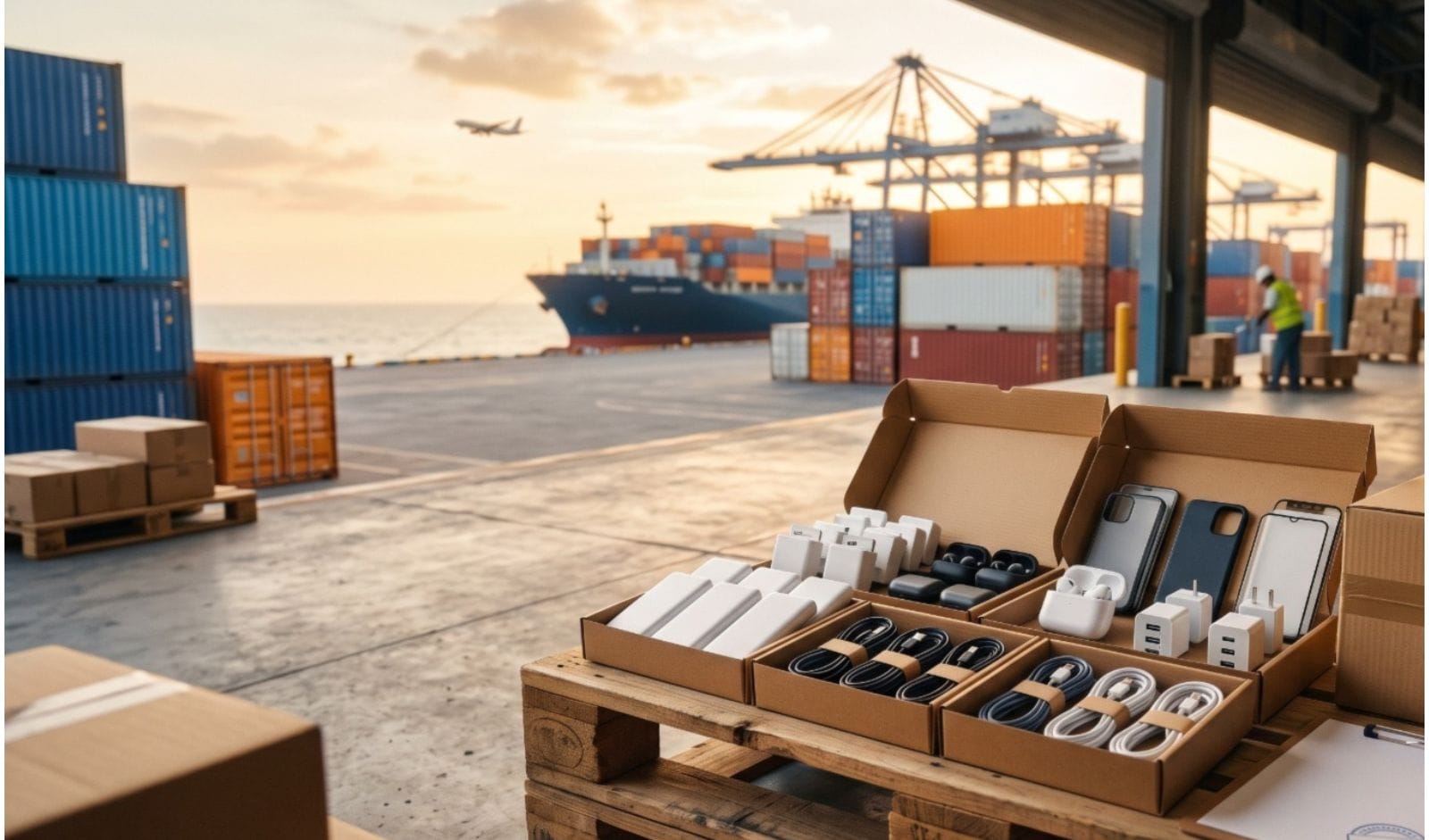
OEM Mobile Accessories Export from India: Process, Documentation & Shipping Guide – India has become an important sourcing destination for mobile accessories and consumer electronics. International brands, distributors, retailers and startups can work with Indian OEM manufacturers to develop and source products such as earbuds, Bluetooth speakers, neckbands, charging cables, mobile chargers, car chargers and other mobile accessories.
However, exporting OEM mobile accessories from India involves several steps beyond manufacturing. Product selection, customization, quality control, documentation, packaging, customs clearance and international shipping all need to be planned properly.
This guide explains the complete process of OEM mobile accessories export from India, including the documents required, shipping methods, packaging considerations and important points for international buyers.
What Is OEM Mobile Accessories Export?
OEM mobile accessories export means manufacturing mobile accessories in India according to the requirements of an international buyer and supplying those products to another country.
An overseas buyer can work with an Indian OEM manufacturer to customize products according to their business requirements.
Customization can include:
- Brand name and logo
- Product design
- Product color
- Technical specifications
- Packaging
- User manual
- Product labels
- Accessories included in the box
- Quantity
- Product features
Common mobile accessories that can be manufactured and exported include:
- TWS wireless earbuds
- Bluetooth speakers
- Bluetooth neckbands
- Wireless headphones
- Wired earphones
- Charging cables
- Type-C cables
- Multi charging cables
- Mobile chargers
- Car chargers
- Mobile stands
- Laptop stands
- Other consumer electronic accessories
The exact export requirements depend on the product, destination country and applicable regulations.
Why Source OEM Mobile Accessories from India?
India has a growing ecosystem for consumer electronics and mobile accessories manufacturing. International businesses can work with Indian manufacturers for product development, bulk manufacturing and private-label production.
Private Label Manufacturing
International brands can sell products under their own brand name by using private-label manufacturing services.
Product Customization
OEM manufacturers can customize products according to the buyer’s specifications, design requirements and target market.
Bulk Manufacturing
Manufacturers can produce products in bulk according to the agreed quantity, specifications and production schedule.
Customized Packaging
Buyers can request customized product boxes, labels, manuals and other packaging materials.
Multiple Product Categories
Businesses can source different types of mobile accessories from an OEM manufacturing partner depending on the manufacturer’s capabilities.
OEM Mobile Accessories Export Process from India
The export process generally starts with product selection and ends with international delivery.
The major steps include:
- Product selection
- Requirement discussion
- Sample development
- MOQ and pricing
- Branding and packaging
- Purchase order confirmation
- Production
- Quality inspection
- Export documentation
- Shipping
- Customs clearance
- Final delivery
Let’s understand each step in detail.
Step 1: Select the Mobile Accessories Product
The first step is selecting the product you want to manufacture and export.
For example, an international buyer may be interested in:
- OEM earbuds
- OEM Bluetooth speakers
- OEM neckbands
- OEM charging cables
- OEM mobile chargers
- OEM car chargers
- OEM headphones
After selecting the product, the buyer should define the required specifications.
These may include:
- Product model
- Material
- Color
- Battery capacity
- Bluetooth version
- Charging port
- Output power
- Driver size
- Playback time
- Product dimensions
- Product weight
- Packaging requirements
- Branding requirements
Having clear specifications helps the manufacturer prepare an accurate quotation and production plan.
Step 2: Discuss Requirements with the OEM Manufacturer
Once the product is selected, the buyer shares the requirements with the manufacturer.
The manufacturer and buyer can discuss:
- Product models
- Available customization
- MOQ
- Product specifications
- Sample availability
- Packaging
- Branding
- Production timeline
- Quality requirements
- Payment terms
- Shipping arrangements
For customized products, all important specifications should be finalized before mass production begins.
Step 3: Request Product Samples
Before placing a large OEM order, international buyers can request samples.
Samples allow buyers to evaluate the product before committing to bulk production.
The buyer can check:
- Build quality
- Product design
- Material and finish
- Sound quality
- Charging performance
- Battery performance
- Bluetooth connectivity
- Product functionality
- Branding
- Packaging
- Accessories
If changes are required, the manufacturer can make modifications before starting mass production.
For private-label products, it is recommended to approve the final product sample and packaging artwork before production.
Step 4: Finalize MOQ and Pricing
After approving the product, the buyer and manufacturer finalize the commercial terms.
Important points include:
- Minimum Order Quantity
- Unit price
- Sample cost
- Packaging cost
- Branding cost
- Customization cost
- Tooling cost, if applicable
- Production timeline
- Payment terms
- Shipping terms
- Inspection requirements
OEM pricing can vary depending on the product specifications, order quantity, customization and packaging requirements.
Step 5: Finalize Branding and Packaging
Branding is an important part of an OEM and private-label export order.
The buyer may provide:
- Company logo
- Brand name
- Packaging design
- Product artwork
- User manual
- Barcode
- Product labels
- Required regulatory information
Before production, the buyer should carefully check the final packaging artwork.
Important details may include:
- Brand name
- Product name
- Model number
- Technical specifications
- Manufacturer information
- Importer information where required
- Country-of-origin information
- Safety information
- Barcode
- Applicable regulatory markings
The requirements can differ between countries, so destination-market requirements should be checked before printing the final packaging.
Step 6: Confirm the Purchase Order
Once the product, pricing, specifications, packaging and commercial terms are finalized, the buyer can confirm the purchase order.
The purchase order or commercial agreement should clearly mention:
- Product name
- Product model
- Quantity
- Unit price
- Total order value
- Specifications
- Packaging requirements
- Delivery terms
- Payment terms
- Shipping terms
- Inspection requirements
A clearly documented order helps reduce misunderstandings during production.
Step 7: Start Production
After order confirmation, the manufacturer begins production.
The manufacturing process may include:
- Raw material or component procurement
- Assembly
- Product customization
- Branding
- Quality testing
- Packaging
- Final inspection
- Shipment preparation
The production timeline depends on product type, order quantity, customization requirements and component availability.
Step 8: Quality Inspection
Quality control is an important part of OEM manufacturing and export.
The manufacturer and buyer should agree on quality standards before production.
Quality checks may include:
- Product appearance
- Build quality
- Charging functionality
- Bluetooth connectivity
- Battery performance
- Audio quality
- Buttons and controls
- Charging ports
- Accessories
- Packaging
- Branding
- Product quantity
For larger export orders, buyers may also arrange third-party inspection before shipment if required.
Step 9: Prepare Export Documentation
Once production is complete, the exporter prepares the required documents for export and customs clearance.
Common export documents can include:
- Commercial Invoice
- Packing List
- Shipping Bill
- Bill of Lading
- Air Waybill
- Certificate of Origin, where applicable
- Purchase Order
- Product-specific compliance documents, where applicable
- Insurance documents, if applicable
The exact documents required depend on the product, destination country and shipping method.
Important Documents for OEM Mobile Accessories Export
Importer Exporter Code (IEC)
An Importer Exporter Code is an important requirement for businesses undertaking import and export activities from India, subject to applicable rules and exemptions.
Exporters should ensure that their IEC and business information are properly maintained.
Commercial Invoice
The commercial invoice contains the commercial details of the shipment.
It generally includes:
- Exporter’s information
- Buyer’s information
- Invoice number
- Invoice date
- Product description
- Quantity
- Unit price
- Total value
- Currency
- Country of origin
- Shipping terms
- Other applicable details
Packing List
The packing list provides details about how the products are packed.
It may include:
- Number of cartons
- Product description
- Quantity
- Net weight
- Gross weight
- Carton dimensions
- Packaging information
The packing list helps logistics providers and customs authorities identify the shipment.
Shipping Bill
The Shipping Bill is an important customs document used for export clearance from India.
It is filed through the applicable customs system by the exporter or their authorized representative.
Bill of Lading
A Bill of Lading is generally used for sea freight.
It contains important shipment and transportation details, including information about the shipper, consignee and carrier.
Air Waybill
An Air Waybill is used for air freight shipments.
It provides shipment and transportation information required for air cargo movement.
Certificate of Origin
Depending on the destination country and buyer requirements, a Certificate of Origin may be required to establish the origin of the products.
The exact requirement depends on the destination and applicable trade arrangements.
Shipping OEM Mobile Accessories from India
After manufacturing and documentation, the exporter can arrange international transportation.
The major shipping options include air freight, sea freight and courier services.
Air Freight
Air freight can be suitable for:
- Smaller commercial shipments
- High-value products
- Urgent orders
- Faster replenishment
- Product samples
Air shipping is generally faster but can cost more than sea freight for large shipments.
Sea Freight
Sea freight is commonly used for larger commercial shipments.
It can be suitable when:
- Order quantities are large
- Delivery time is less urgent
- Shipping cost optimization is important
- The shipment is suitable for containerized transportation
Depending on the shipment size, the cargo can be shipped through FCL or LCL arrangements.
Courier Shipping
Courier services can be useful for:
- Product samples
- Small shipments
- Documents
- Initial testing orders
The suitability of courier shipping depends on the product, destination and carrier requirements.
Shipping Terms for OEM Export Orders
International OEM transactions may use Incoterms to define responsibilities between the seller and buyer.
Common Incoterms include:
EXW
Under Ex Works, the buyer generally takes responsibility for arranging transportation from the agreed pickup location, subject to the agreed terms.
FOB
Under FOB, the seller handles the agreed responsibilities up to loading the goods on board the vessel at the specified port. The buyer handles subsequent responsibilities according to the agreed terms.
CIF
Under CIF, the seller arranges the agreed freight and insurance to the destination port according to the applicable Incoterm conditions.
DDP
Under DDP, the seller generally takes on a broader range of responsibilities, including delivery and import formalities where applicable.
The exact responsibilities should always be confirmed in the commercial agreement and applicable Incoterms rules.
Battery Products and International Shipping
Many wireless mobile accessories contain lithium-ion or lithium-polymer batteries.
Examples include:
- TWS earbuds
- Bluetooth speakers
- Bluetooth neckbands
- Wireless headphones
Battery-containing products may require additional shipping considerations.
These can include:
- Battery specifications
- Packaging requirements
- Transport documentation
- Dangerous-goods requirements where applicable
- Carrier approval
- Testing documentation
- Destination-country requirements
Before shipping battery-powered products internationally, exporters should confirm the applicable requirements with their freight forwarder or carrier.
OEM Packaging for Export
Export packaging should protect products during international transportation.
A typical packaging structure can be:
Product → Inner Packaging → Retail Box → Master Carton → Pallet, where applicable
Important packaging considerations include:
- Strong cartons
- Internal product protection
- Moisture protection where required
- Proper carton labeling
- Correct product quantity
- Gross weight
- Net weight
- Carton dimensions
- Appropriate handling markings
Proper packaging can help reduce the risk of damage during loading, unloading and transportation.
Product Labeling for International Markets
Different countries have different labeling and compliance requirements.
Depending on the product and destination, labels may require information such as:
- Brand name
- Model number
- Product specifications
- Manufacturer information
- Importer information
- Country of origin
- Battery information
- Safety information
- Regulatory markings
- Recycling or disposal information
International buyers should confirm the destination-market requirements before finalizing packaging artwork.
Customs Clearance for OEM Mobile Accessories
Customs clearance is an important part of international trade.
Customs authorities may review:
- Product description
- Declared value
- HS classification
- Quantity
- Country of origin
- Supporting documents
- Applicable duties and taxes
- Product-specific compliance requirements
Correct classification and accurate documentation can help avoid unnecessary delays.
For international shipments, exporters can work with experienced customs brokers or freight forwarders when required.
HS Code for Mobile Accessories
HS codes are used to classify products for international trade.
Different mobile accessories may have different HS classifications.
For example, earbuds, Bluetooth speakers, mobile chargers and charging cables may not necessarily have the same HS code.
Therefore, exporters should determine the appropriate classification for the exact product instead of using one general HS code for all mobile accessories.
Payment Methods for OEM Export Orders
Different payment methods can be used for international OEM transactions depending on the buyer, manufacturer and commercial agreement.
Common arrangements include:
- Advance payment
- Partial advance and balance before shipment
- Letter of Credit
- Bank-based trade arrangements
- Other mutually agreed payment terms
Payment conditions should be clearly mentioned in the purchase agreement or proforma invoice.
What International Buyers Should Provide to an OEM Manufacturer
To receive an accurate quotation, international buyers should provide detailed requirements.
Product Requirements
- Product category
- Product model
- Required specifications
- Quantity
- Target market
Branding Requirements
- Brand name
- Logo
- Product color
- Packaging requirements
- User manual requirements
Shipping Information
- Destination country
- Destination city or port
- Preferred shipping method
- Required delivery timeline
Commercial Information
- Required quantity
- Payment preference
- Preferred Incoterm
- Inspection requirements
Providing complete information at the beginning helps the manufacturer prepare a more accurate quotation.
Common Challenges in OEM Mobile Accessories Export
Product Compliance
Products may need to meet specific requirements in the destination market.
Battery Shipping
Wireless products containing batteries may require additional shipping and documentation procedures.
Documentation Errors
Incorrect product descriptions, quantities, values or shipment details can cause customs or logistics issues.
Packaging Damage
Insufficient packaging can increase the risk of product damage during international transportation.
Quality Consistency
Large OEM orders require consistent quality across the entire production batch.
Delivery Delays
Production schedules, customs procedures, shipping schedules and destination clearance can affect the final delivery timeline.
How to Choose an OEM Mobile Accessories Manufacturer in India
Before selecting an OEM manufacturer, international buyers should evaluate several factors.
Manufacturing Capability
Check whether the manufacturer can produce the required product category and quantity.
Customization Options
Ask which aspects can be customized, such as:
- Product design
- Logo
- Color
- Packaging
- Accessories
- Technical specifications
Quality Control
Ask about the manufacturer’s quality inspection and testing procedures.
MOQ
Confirm the minimum order quantity for standard products as well as customized products.
Production Capacity
For recurring orders, confirm whether the manufacturer can support future production requirements.
Export Experience
Experience with international orders can help with documentation, logistics and communication.
Communication
Clear communication is important for specifications, approvals, production updates and shipping coordination.
OEM vs Private Label Mobile Accessories
OEM and private-label manufacturing are related but can involve different levels of customization.
OEM Manufacturing
OEM projects can involve modifications to product specifications, design, functionality or other product characteristics according to the buyer’s requirements.
Private Label Manufacturing
Private-label manufacturing generally involves selling a product under the buyer’s own brand, often with customized branding and packaging.
For example, a business may select an existing wireless earbud model, add its brand logo and customized packaging, and sell it under its own brand.
For a more customized product, the buyer can work with the manufacturer on specifications, design and other product requirements.
OEM Mobile Accessories Export Timeline
The overall timeline depends on the product and order requirements.
A typical OEM export project may follow this process:
Requirement Discussion → Quotation → Sample → Sample Approval → Artwork Approval → Purchase Order → Production → Quality Inspection → Documentation → Shipment → Customs Clearance → Delivery
The actual timeline can vary depending on:
- Product category
- Customization
- Order quantity
- Component availability
- Packaging
- Testing
- Shipping method
- Destination country
- Customs procedures
Buyers should confirm the production and shipping schedule with the manufacturer before placing an order.
OEM Mobile Accessories Export Checklist
Before exporting an OEM mobile accessories order from India, buyers and exporters should check the following.
Product
- Product specifications finalized
- Sample approved
- Quantity confirmed
- Quality standards agreed
Branding
- Logo approved
- Packaging artwork approved
- Labels checked
- User manual finalized
Commercial
- Purchase order confirmed
- Price finalized
- Payment terms agreed
- Incoterm agreed
Documentation
- Commercial invoice prepared
- Packing list prepared
- Shipping documentation prepared
- Certificate of Origin arranged if required
- Product-specific documents arranged if required
Shipping
- Freight method selected
- Freight forwarder confirmed
- Battery shipping requirements checked where applicable
- Destination requirements verified
- Insurance arranged if required
Final Thoughts
Exporting OEM mobile accessories from India involves several stages, from product selection and customization to manufacturing, quality control, documentation, customs clearance and international shipping.
For international brands, retailers and distributors, working with an experienced OEM mobile accessories manufacturer in India can help simplify the sourcing and manufacturing process.
Products such as earbuds, Bluetooth speakers, neckbands, chargers and charging cables can be developed or sourced according to the buyer’s product, branding and packaging requirements.
Before starting an export order, buyers should clearly define product specifications, MOQ, branding, packaging, compliance requirements, payment terms and shipping responsibilities.
A well-planned OEM export process can help both manufacturers and international buyers manage orders more efficiently and build a reliable long-term supply chain.
Looking for an OEM Mobile Accessories Manufacturer in India?
If you are looking to source OEM mobile accessories from India, you can discuss your product requirements, customization needs, MOQ and packaging requirements with an experienced OEM manufacturer.
Whether you are launching a new private-label brand or expanding an existing mobile accessories business, an Indian OEM partner can help you develop and manufacture products according to your requirements.
Planning Your Own Mobile Accessories Brand
Get an OEM manufacturing quote based on your product, quantity, specifications, branding and packaging requirements.Discuss your requirements for earbuds, neckbands, Bluetooth speakers, chargers, cables, headphones, car chargers and mobile stands.