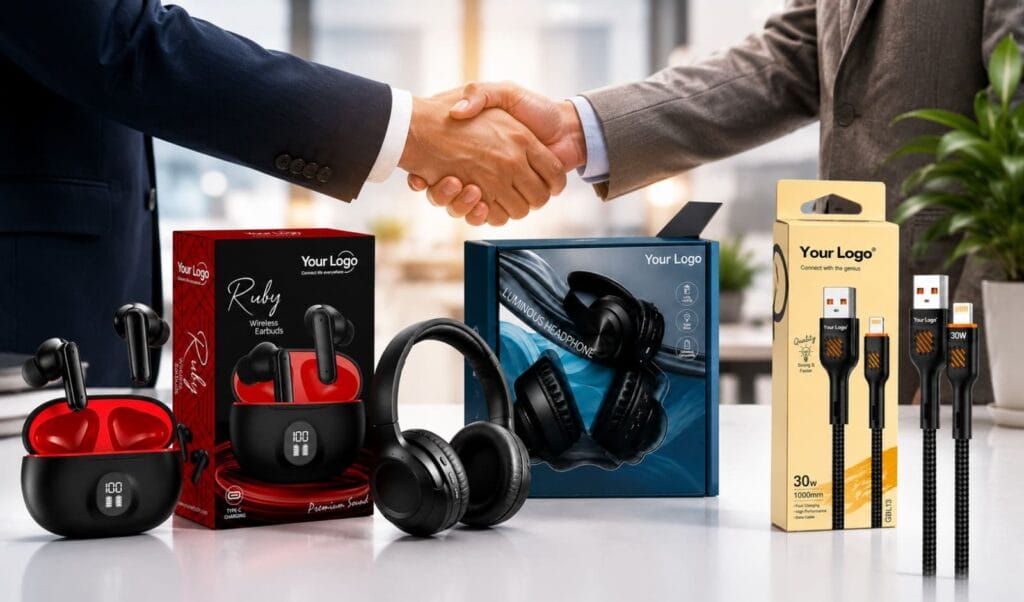
Right OEM manufacturer in India is one of the most important decisions for any business planning to launch products under its own brand. Whether you are a startup, retailer, distributor, e-commerce seller, importer, exporter, or an established brand, your OEM manufacturing partner directly affects product quality, pricing, delivery timelines, customization, packaging, and ultimately your brand reputation.
India has a growing manufacturing ecosystem across electronics, mobile accessories, consumer products, automotive components, electrical products, and many other industries. However, not every manufacturer offers the same production capabilities, quality standards, MOQ, customization options, or after-sales support.
This guide explains how to choose an OEM manufacturer in India, what questions to ask, what factors to compare, and which mistakes to avoid before placing a bulk manufacturing order.
What Is an OEM Manufacturer?
OEM stands for Original Equipment Manufacturer. An OEM manufacturer produces products or components according to another company’s requirements, which can then be sold under that company’s brand.
Depending on the manufacturer and product category, OEM services may include product manufacturing, specification customization, logo printing, private label branding, packaging customization, bulk production, quality testing, and product development.
For businesses that do not want to establish their own manufacturing facility, working with an OEM partner can provide a practical way to introduce branded products to the market.
Why Choosing the Right OEM Manufacturer Matters
Your manufacturer is not simply a supplier. The manufacturer becomes an important part of your supply chain.
If product quality is inconsistent, customers associate the problem with your brand rather than the factory producing the product.
Similarly, production delays can affect product launches, inventory availability, distributor relationships, marketplace performance, and customer satisfaction.
A reliable OEM manufacturing partner can help you maintain consistent product quality, control costs, develop customized products, manage production timelines, and scale manufacturing as your business grows.
Step 1: Define Your Product Requirements
Before searching for an OEM manufacturer in India, clearly define what you want to manufacture.
Prepare basic requirements such as product category, specifications, materials, features, colors, branding requirements, packaging, estimated quantity, target price range, and expected delivery timeline.
For example, if you are looking for an OEM mobile accessories manufacturer, specify whether you need wireless earbuds, Bluetooth speakers, chargers, charging cables, neckbands, wired earphones, headphones, car chargers, or mobile stands.
The clearer your requirements are, the easier it becomes to compare manufacturers accurately.
Step 2: Check the Manufacturer’s Product Specialization
Not every factory is suitable for every product.
A manufacturer specializing in charging products may have different equipment, testing processes, technical expertise, and supply chains compared with a manufacturer specializing in audio products.
Look for manufacturers with relevant experience in your required product category.
For mobile accessories, this could include expertise in categories such as:
- Wireless earbuds
- Bluetooth speakers
- Neckbands
- Headphones
- Wired earphones
- Mobile chargers
- Car chargers
- Charging cables
- Multi charging cables
- Mobile stands
Relevant specialization can make product development and quality control easier.
Step 3: Evaluate Manufacturing Capabilities
Before finalizing an OEM supplier, understand what the company can actually manufacture or customize.
Ask about production capacity, available machinery, assembly capabilities, quality-control procedures, packaging facilities, customization processes, and monthly production capacity.
You should also understand which operations are completed internally and which are outsourced.
This information can help you evaluate whether the manufacturer can support your current order quantity as well as future growth.
Step 4: Ask About OEM and ODM Services
OEM and ODM are related but different manufacturing models.
OEM manufacturing generally focuses on producing products according to the buyer’s specifications or branding requirements.
ODM manufacturing can involve greater product design and development support.
If you only need an existing product with your logo and customized packaging, an OEM or private label solution may be sufficient.
If you want significant changes in design, features, specifications, materials, or functionality, discuss ODM capabilities with the manufacturer.
Choosing the appropriate manufacturing model can save both time and development costs.
Step 5: Check Custom Branding Options
Branding is especially important when you plan to sell products under your own name.
Ask whether the manufacturer provides custom logo printing on the product itself.
Depending on the product and manufacturing process, branding options may include logo printing, engraving, model-name printing, custom colors, labels, and other brand-specific elements.
Request samples or photographs of previous branding work to understand the expected printing quality.
Your logo should remain consistent and clearly visible across your product range.
Step 6: Check Private Label Packaging Options
Packaging plays an important role in product presentation and customer experience.
A professional OEM manufacturer may provide private label packaging options such as custom boxes, product inserts, labels, manuals, stickers, barcodes, and other packaging elements.
Ask about minimum quantities for customized packaging because packaging MOQ may differ from the product MOQ.
Also confirm who will prepare the packaging artwork and what file formats or dimensions are required.
Step 7: Understand the Minimum Order Quantity
MOQ stands for Minimum Order Quantity, which is the minimum quantity a manufacturer is willing to produce for a particular order.
MOQ can depend on the product, customization level, raw materials, packaging requirements, and production process.
A simple logo customization on an existing product may have a different MOQ from a completely customized ODM product.
For startups and new brands, flexible MOQ can be particularly useful because it allows initial market testing without excessive inventory investment.
However, the lowest MOQ should not be the only reason for selecting a manufacturer.
Step 8: Always Request Product Samples
Samples are one of the best ways to evaluate an OEM manufacturer’s capabilities.
Never judge product quality only through photographs, videos, catalogues, or quotations.
Order samples and test them yourself.
For electronic products, check build quality, functionality, performance, materials, durability, packaging, and overall finishing.
For audio accessories, evaluate sound quality, microphone quality, connectivity, battery performance, controls, and comfort.
For charging products, evaluate charging performance, connector quality, compatibility, construction, and heat management.
Sample testing can identify potential problems before you commit to bulk manufacturing.
Step 9: Compare Product Quality, Not Just Price
One of the most common mistakes businesses make is selecting the manufacturer offering the lowest quotation.
A lower unit price may look attractive initially, but poor quality can increase returns, replacements, customer complaints, and negative reviews.
Instead of comparing only prices, compare the overall value offered by different manufacturers.
Evaluate product specifications, materials, components, finishing, testing, warranty support, packaging quality, customization, and production reliability.
A slightly higher manufacturing cost can sometimes provide better long-term value if it results in fewer product failures and stronger customer satisfaction.
Step 10: Understand the Quality Control Process
Quality control should be discussed before production begins.
Ask the manufacturer what testing procedures are performed during and after production.
Depending on the product category, quality checks may cover functionality, charging performance, connectivity, battery performance, audio performance, physical construction, packaging, and visual inspection.
You should also clarify how defective units are handled and what happens if the bulk production quality differs from the approved sample.
Having clear quality expectations before production can reduce disputes later.
Step 11: Verify Certifications and Compliance Requirements
Different products may be subject to different regulatory, safety, labeling, testing, or certification requirements.
Ask the manufacturer which certifications or test reports are available for your selected product.
Businesses should independently verify which Indian regulations and certifications apply to their specific products and business model.
Requirements can differ depending on the product category and whether the product is manufactured domestically, imported, distributed, or sold through particular channels.
Do not assume that one certification applies to every electronic product.
Step 12: Evaluate Pricing and Total Cost
The lowest factory price is not necessarily your final cost.
When comparing manufacturers, calculate the complete landed or procurement cost.
Consider product price, logo customization, packaging, tooling or development charges, transportation, taxes, warehousing, inspection, testing, warranty, and replacement costs.
For e-commerce businesses, you may also need to include marketplace commissions, shipping, returns, and advertising expenses when calculating your final selling price.
A clear cost structure makes negotiations easier and protects your profit margin.
Step 13: Check Production and Delivery Timelines
Ask for realistic production timelines before confirming an order.
The timeline can vary based on quantity, customization, packaging, raw material availability, and production schedules.
Confirm approximately how much time is required for sample approval, logo customization, packaging production, bulk manufacturing, quality inspection, and dispatch.
If you have a specific launch date, communicate it before placing the order.
Avoid relying only on verbal promises for critical deadlines.
Step 14: Evaluate Communication and Responsiveness
Communication quality can reveal a lot about a potential manufacturing partner.
A professional supplier should be able to answer technical questions, provide specifications, explain customization limitations, share production updates, and respond to problems clearly.
Poor communication during the enquiry stage may become an even larger problem after you place a bulk order.
Look for a manufacturer that provides clear information rather than simply agreeing to every request.
Step 15: Discuss Warranty and After-Sales Support
Electronic products can occasionally develop defects, making warranty and replacement policies important.
Before placing an order, discuss the manufacturer’s policy for defective products.
Ask how manufacturing defects are identified, what percentage of defective units is considered acceptable, whether replacements or credits are provided, and how claims are handled.
These terms should ideally be documented before bulk production.
Step 16: Check the Manufacturer’s Scalability
Your initial order may be small, but your manufacturing requirements could increase if your product performs well.
Ask whether the OEM manufacturer can support higher production volumes in the future.
A suitable long-term partner should be able to help you move from initial market testing to larger production runs without major quality or delivery problems.
Scalability is particularly important for brands planning to build distributor networks or expand into multiple sales channels.
Step 17: Compare Multiple OEM Manufacturers
Avoid finalizing the first manufacturer you contact.
Shortlist several manufacturers and compare their capabilities.
You can create a comparison based on:
- Product quality
- Manufacturing capabilities
- OEM services
- ODM capabilities
- MOQ
- Pricing
- Custom logo options
- Private label packaging
- Sample quality
- Quality control
- Production capacity
- Delivery timeline
- Communication
- Warranty support
This makes your final decision more objective.
Step 18: Start With a Trial Order
Even after successful sample testing, starting with a manageable first order can reduce risk.
A trial production order helps you evaluate whether the manufacturer can maintain sample-level quality during bulk manufacturing.
It also allows you to assess packaging consistency, delivery timelines, communication, documentation, and after-sales support.
Once the manufacturer demonstrates reliability, you can gradually increase order quantities.
Red Flags to Avoid When Choosing an OEM Manufacturer
Be cautious if a manufacturer refuses to provide clear specifications, avoids discussing quality control, provides unusually low prices without explanation, changes quotations repeatedly, refuses samples, cannot explain production capabilities, or promises unrealistic delivery times.
Another warning sign is when a supplier agrees to every customization request without discussing technical limitations, MOQ, development costs, or production feasibility.
A trustworthy manufacturing partner should be transparent about both capabilities and limitations.
How to Choose an OEM Mobile Accessories Manufacturer in India
If your business specifically focuses on mobile accessories, choose a manufacturer with experience in both OEM mobile accessories manufacturing and private label branding.
Evaluate whether the manufacturer can support your required categories, such as audio devices, charging products, or mobile stands.
For example, an OEM mobile accessories business may require products such as earbuds, Bluetooth speakers, neckbands, headphones, wired earphones, chargers, charging cables, car chargers, multi charging cables, and mobile stands.
Instead of working with a supplier based only on catalogue size, focus on product quality, customization capabilities, MOQ, packaging, production consistency, and support.
OEM Manufacturer vs Supplier: What Is the Difference?
A manufacturer is directly involved in producing or assembling products, while a supplier may source and resell products produced by other companies.
Both business models can be useful depending on your requirements.
However, if you require significant product customization, large production volumes, technical changes, or ODM development, understanding who actually manufactures the product becomes more important.
Ask potential partners clearly about their role in the production process.
Questions to Ask an OEM Manufacturer Before Ordering
Before confirming an OEM manufacturing order, ask questions such as:
- What is your MOQ?
- Can you provide product samples?
- Do you provide OEM and ODM services?
- Can you customize product specifications?
- Do you offer custom logo printing?
- Can you create private label packaging?
- What is your production capacity?
- What quality-control procedures do you follow?
- What certifications or test reports are available?
- How long does bulk production take?
- What are your payment terms?
- How do you handle defective products?
- Can you support larger future orders?
Getting these answers before paying for bulk production can significantly reduce manufacturing risk.
Benefits of Choosing an OEM Manufacturer in India
Working with an OEM manufacturer in India can provide businesses with access to local manufacturing, customization, private label branding, bulk production, and potentially shorter domestic supply chains.
Businesses may also find it easier to communicate requirements, evaluate samples, coordinate packaging, and manage repeat orders when working with a suitable domestic manufacturing partner.
The actual benefits depend on the manufacturer, product category, location, production requirements, and supply chain.
Common Mistakes When Selecting an OEM Manufacturer
One major mistake is focusing entirely on price.
Businesses also make mistakes by skipping sample testing, failing to document specifications, ignoring packaging requirements, ordering excessive quantities initially, not discussing defective products, and assuming certifications without verification.
Another mistake is frequently changing manufacturers to save small amounts on unit costs.
Once you find a reliable manufacturing partner capable of maintaining consistent quality and competitive pricing, developing a long-term relationship can improve manufacturing efficiency.
Frequently Asked Questions
How do I find the right OEM manufacturer in India?
Define your product requirements, research manufacturers specializing in your category, request samples, compare quality and pricing, verify manufacturing capabilities, discuss MOQ and customization, understand quality control, and start with a manageable first order.
What should I check before choosing an OEM manufacturer?
Check product quality, manufacturing capabilities, MOQ, pricing, samples, OEM and ODM services, custom branding, packaging, certifications where applicable, production capacity, delivery timelines, communication, and after-sales support.
Should I choose the cheapest OEM manufacturer?
Not necessarily. Selecting manufacturers entirely based on price can increase the risk of inconsistent quality. Compare overall value, including specifications, quality, testing, customization, packaging, reliability, and support.
What is MOQ in OEM manufacturing?
MOQ means Minimum Order Quantity. It represents the minimum quantity a manufacturer requires for an order. MOQ varies according to product type, customization, packaging, materials, and manufacturing process.
Can an OEM manufacturer put my logo on products?
Many OEM manufacturers provide custom logo printing and private label branding. Availability and MOQ depend on the product and manufacturing process.
What is the difference between OEM and ODM manufacturing?
OEM generally involves manufacturing products according to a buyer’s specifications or branding requirements. ODM generally provides greater involvement in product design and development. Exact services vary between manufacturers.
Should I order a sample before bulk manufacturing?
Yes. Sample testing helps evaluate product quality, specifications, functionality, materials, finishing, and packaging before committing to a larger production order.
Conclusion
Choosing the right OEM manufacturer in India requires more than comparing quotations. Your manufacturing partner can directly influence your product quality, delivery reliability, customization capabilities, customer satisfaction, and brand reputation.
Start by clearly defining your product requirements and shortlist manufacturers with relevant industry experience. Compare their samples, MOQ, OEM and ODM capabilities, private label packaging, custom branding, quality-control procedures, production capacity, pricing, and after-sales support.
For businesses entering the mobile accessories market, working with an experienced OEM mobile accessories manufacturer in India can help simplify product sourcing, branding, packaging, and bulk production.
Take time to test samples and start with a manageable order before scaling. A reliable OEM manufacturing partnership can become an important foundation for building and growing your brand in India.
Planning Your Own Mobile Accessories Brand
Get an OEM manufacturing quote based on your product, quantity, specifications, branding and packaging requirements.Discuss your requirements for earbuds, neckbands, Bluetooth speakers, chargers, cables, headphones, car chargers and mobile stands.