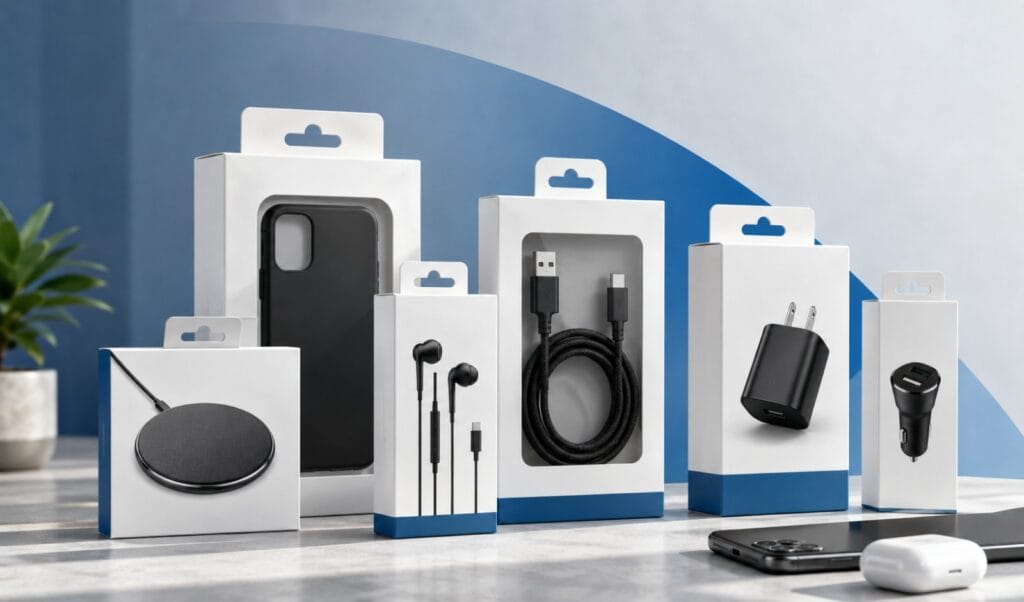
In the competitive mobile accessories market, product quality is only one part of building a successful brand. Packaging plays an equally important role in how customers perceive your products. Whether you are launching wireless earbuds, mobile chargers, charging cables, Bluetooth speakers, neckbands, car chargers, or other accessories, professional OEM mobile accessories packaging can help establish a strong and recognizable brand identity.
For retailers, distributors, e-commerce sellers, startups, and established brands, custom and private label packaging provides the opportunity to sell products under their own brand name while maintaining a consistent and professional presentation.
This complete guide explains OEM packaging, private label packaging, customization options, materials, design considerations, packaging processes, and how to choose the right packaging solution for your mobile accessories business.
What Is OEM Mobile Accessories Packaging?
OEM mobile accessories packaging refers to packaging developed or customized specifically for products manufactured under an OEM arrangement.
Instead of selling a product in generic packaging, businesses can customize elements such as:
- Brand name and logo
- Product model name
- Brand colors
- Packaging dimensions
- Product specifications
- Features and benefits
- Barcode and QR code
- Contact information
- Importer or marketer information
- Instruction details
- Warranty information
For example, if a business orders wireless earbuds from an OEM manufacturer, the earbuds can carry the buyer’s logo while the retail box can also be designed according to the buyer’s branding.
This creates a complete branded product that is ready for distribution or retail sale.
What Is Private Label Packaging?
Private label packaging allows businesses to sell products manufactured by another company under their own brand identity.
The manufacturer handles product manufacturing and packaging according to the buyer’s requirements, while the final product is presented under the buyer’s brand.
For example, a company may select an existing Bluetooth speaker model and customize it with its logo, brand colors, packaging design, product information, and barcode.
The finished product can then be marketed as part of that company’s own product range.
Private label packaging is especially useful for:
- Mobile accessories brands
- Startups
- Retail chains
- Distributors
- Wholesalers
- Importers and exporters
- E-commerce sellers
- Corporate gifting companies
It allows businesses to enter or expand in the mobile accessories market without developing every product and packaging component independently.
OEM Packaging vs Private Label Packaging
Although OEM and private label packaging are closely related, there can be differences depending on the level of customization required.
OEM packaging can involve extensive customization according to the buyer’s product, branding, specifications, dimensions, and packaging requirements.
Private label packaging generally focuses on taking an existing product and presenting it under the buyer’s brand using customized logos, graphics, labels, and retail packaging.
Both options can help businesses create a professional branded product line.
Why Is Custom Packaging Important for Mobile Accessories?
Packaging is often the first physical interaction customers have with a product. A well-designed package can communicate quality before the customer even opens the box.
1. Builds Brand Identity
Consistent logo placement, colors, typography, and design make your products easier to recognize.
When multiple products follow the same packaging style, they create a unified brand identity.
2. Improves Product Presentation
Professional packaging can make even a simple mobile accessory look more premium and retail-ready.
This becomes particularly important when products are displayed in stores or photographed for online marketplaces.
3. Protects Products
Mobile accessories contain components that can be damaged by impacts, dust, scratches, or improper handling.
Appropriate packaging helps protect products during storage and transportation.
4. Supports Retail Sales
Good packaging clearly communicates what the product is and its important specifications.
Customers should be able to quickly identify information such as product type, compatibility, output, connectivity, or other relevant specifications.
5. Helps Build Customer Trust
Professional and consistent packaging can make a new brand appear more established and reliable.
Clear specifications, manufacturer information, warranty details, and proper labeling also improve transparency.
Types of Custom Packaging for Mobile Accessories
Different products require different packaging structures. The right option depends on the product dimensions, positioning, budget, and target market.
Folding Carton Boxes
Folding cartons are widely used for mobile accessories because they are lightweight, customizable, and suitable for mass production.
They can be used for:
- Charging cables
- Wired earphones
- Mobile chargers
- Car chargers
- Small mobile accessories
The exterior can be customized with branding, specifications, product images, and other required information.
Rigid Boxes
Rigid boxes provide a more premium presentation and are commonly considered for higher-value products.
They are suitable for:
- Premium wireless earbuds
- Headphones
- Bluetooth speakers
- Corporate gift products
- Premium accessory collections
Their stronger construction can also provide additional product protection.
Sliding or Drawer Boxes
Drawer-style packaging consists of an outer sleeve and an inner sliding tray.
This style creates a premium unboxing experience and works particularly well for earbuds, earphones, cables, and other compact accessories.
Hanging Retail Boxes
Packaging with a hanging tab is useful for physical retail stores where products are displayed on hooks or racks.
It is commonly used for cables, chargers, earphones, adapters, and small accessories.
Window Packaging
A transparent window allows customers to see the actual product without opening the box.
This can be useful when product design, color, or finish is an important selling point.
Mobile Accessories That Can Use Custom Packaging
OEM and private label packaging can be developed for a wide range of products.
Wireless Earbuds Packaging
Earbuds packaging can include:
- Custom logo
- Product image
- Model name
- Bluetooth information
- Battery specifications
- Charging information
- Key features
- Barcode or QR code
- Warranty details
Premium earbuds can also use rigid or drawer-style packaging for a better unboxing experience.
Neckband Packaging
Neckband packaging requires enough internal space to hold the neckband securely without excessive bending.
Custom inserts can help maintain the correct product position.
Bluetooth Speaker Packaging
Speaker packaging usually requires stronger materials because speakers can be heavier than smaller accessories.
Protective inserts can reduce movement during transportation.
Mobile Charger Packaging
Packaging for mobile chargers should clearly display relevant specifications such as:
- Output power
- Port configuration
- Input specifications
- Supported charging technology
- Compatibility information
The internal structure should also keep the charger securely positioned.
Charging Cable Packaging
Charging cables can use compact boxes, hanging cartons, sleeves, or other retail packaging formats.
Important information can include connector type, cable length, supported charging power, and compatibility.
Car Charger Packaging
Car charger packaging is generally compact and can include information about output power, available ports, compatibility, and charging features.
Wired Earphone Packaging
Wired earphones can use folding cartons, hanging boxes, window packaging, or premium drawer-style boxes depending on the target price segment.
Headphone Packaging
Headphones generally require larger boxes with protective inserts because of their size.
Packaging should protect the headband and earcups while keeping the product properly positioned.
Custom Packaging Options for Your Brand
One of the main advantages of OEM manufacturing is the ability to customize packaging according to your branding strategy.
Custom Logo Printing
Your brand logo can be printed prominently on the front, sides, or back of the packaging.
The same branding can also be applied to the product where technically possible.
Custom Brand Colors
Using consistent colors across your packaging makes the product range easier to recognize.
For example, the same primary and secondary colors can be used across earbuds, chargers, cables, and speakers.
Custom Product Images
High-quality product renders or photographs can be incorporated into the packaging design.
The product shown on the box should accurately represent the actual item inside.
Custom Typography
Typography should remain consistent with the overall brand identity and must be easy to read.
Avoid overcrowding the package with too many font styles or unnecessary text.
Barcode and QR Code
Businesses can add barcodes, SKU information, serial numbers, or QR codes depending on their inventory and retail requirements.
QR codes can direct customers to product information, registration pages, manuals, or support resources.
Product Specifications
Technical specifications should be clearly displayed and verified before printing.
Incorrect wattage, battery capacity, compatibility, or other technical information can create customer confusion and unnecessary returns.
Warranty Information
If the product includes a warranty, basic warranty information can be printed on the box or included through a warranty card.
Packaging Materials for Mobile Accessories
Choosing the right material affects durability, appearance, cost, and product protection.
Common options include:
Paperboard: Lightweight and widely used for standard retail packaging.
Corrugated material: Offers additional strength and can be useful for larger or heavier products.
Rigid board: Provides a premium feel and stronger construction.
Molded pulp inserts: Can hold products securely while reducing dependence on certain plastic inserts.
Plastic or PET windows: Used when the product needs to remain visible through the packaging.
Material selection should consider product weight, transportation requirements, desired presentation, and budget.
Importance of Internal Packaging and Inserts
The outside of the box attracts attention, but the inside protects the product.
Internal packaging may include:
- Cardboard inserts
- Molded trays
- Pulp trays
- Foam protection where appropriate
- Product sleeves
- Cable compartments
A correctly designed insert prevents excessive movement and helps organize the product and included accessories.
For example, an earbuds package may contain separate positions for the charging case, charging cable, additional ear tips, and user manual.
What Information Should Be Printed on Mobile Accessories Packaging?
The exact information depends on the product and applicable market requirements, but common packaging elements include:
- Brand name
- Product name
- Model number
- Product specifications
- Compatibility details
- Manufacturer information
- Importer or marketer details where applicable
- Country of origin where required
- MRP or pricing information where applicable
- Customer support information
- Barcode
- QR code
- Warranty information
- Package contents
- Required certifications or compliance marks
Businesses should verify applicable legal, labeling, and marketplace requirements before final production.
OEM Mobile Accessories Packaging Process
A structured packaging development process helps reduce printing errors and production delays.
Step 1: Select the Product
The first step is finalizing the mobile accessory you want to manufacture or private label.
This determines packaging dimensions and protection requirements.
Step 2: Choose the Packaging Type
Select a packaging format according to the product, budget, and desired market positioning.
For example, an economical charging cable may use a folding carton, while premium earbuds may use a rigid drawer box.
Step 3: Share Your Branding Requirements
Provide the manufacturer with your:
- Logo
- Brand colors
- Product name
- Product specifications
- Required text
- Barcode
- QR code
- Contact details
- Other mandatory information
High-resolution or vector logo files are generally preferred for professional printing.
Step 4: Create the Packaging Design
The packaging artwork is prepared according to the box dimensions and printing requirements.
Brand elements, product images, specifications, and required information are positioned within the design.
Step 5: Review the Artwork
This is one of the most important stages.
Before approval, carefully verify:
- Spelling
- Logo
- Product model
- Wattage
- Battery specifications
- Connector type
- Product images
- Barcode
- Contact details
- Regulatory information
Step 6: Approve Sample or Final Artwork
Depending on the project, a packaging sample, mockup, digital proof, or production sample may be reviewed before bulk production.
Step 7: Bulk Packaging Production
After approval, the packaging moves into bulk manufacturing and printing.
Step 8: Product Packing and Quality Check
Products are placed inside their packaging and inspected before final shipment.
Quality checks can include print quality, box condition, product placement, labeling, and packaging accuracy.
How to Design Premium Mobile Accessories Packaging
Premium packaging does not necessarily mean adding more graphics or text.
In many cases, simpler packaging appears more professional.
Use a clear visual hierarchy where the brand, product name, and essential information are immediately visible.
Maintain enough empty space around important design elements and avoid filling every available area.
Product images should be sharp and realistic, while colors should remain consistent across the product range.
For premium products, finishes such as matte lamination, spot UV, embossing, debossing, or foil details may also be considered depending on manufacturing capabilities and budget.
Packaging for E-Commerce vs Offline Retail
Packaging requirements can differ depending on where the products will be sold.
E-Commerce Packaging
For online marketplaces, product presentation in listing images is important, but packaging must also survive shipping and handling.
Businesses should consider both the retail box and appropriate outer shipping protection.
Offline Retail Packaging
Physical stores require packaging that attracts attention on shelves and communicates important information quickly.
Hanging tabs, windows, strong front-facing branding, and clear product identification can be particularly useful.
A brand selling through both channels should ideally develop packaging that works effectively for online photography as well as physical retail displays.
Common Packaging Mistakes to Avoid
One of the biggest mistakes is approving packaging before checking the technical specifications carefully.
Other common problems include:
- Incorrect product images
- Wrong wattage or battery information
- Poor-quality logo files
- Too much text
- Very small fonts
- Weak product protection
- Inconsistent brand colors
- Incorrect barcode
- Missing required labeling
- Using the same packaging dimensions for different products without checking fit
Creating a proper approval checklist before printing can prevent many of these problems.
Custom Packaging for Building a Complete Mobile Accessories Brand
A major advantage of OEM and private label manufacturing is that businesses can build an entire product portfolio under one consistent brand.
For example, a mobile accessories brand can offer:
- Wireless earbuds
- Bluetooth neckbands
- Bluetooth speakers
- Wired earphones
- Wireless headphones
- Mobile chargers
- Car chargers
- Charging cables
- Multi-charging cables
- Mobile stands
Using consistent packaging across these categories can create a stronger brand presence and make the entire range look professionally connected.
How to Choose an OEM Packaging Partner
When selecting an OEM mobile accessories manufacturer or packaging partner, evaluate more than just packaging price.
Consider whether the supplier can support:
- Multiple mobile accessories categories
- Custom logo printing
- Private label packaging
- Custom box design
- Packaging samples
- Product and packaging customization
- Quality inspection
- Flexible MOQ options
- Bulk manufacturing
- Consistent packaging across multiple products
Working with a manufacturer that can coordinate both the product and packaging can simplify the overall sourcing process.
Final Thoughts
OEM mobile accessories packaging is much more than a box around a product. It protects the product, communicates important information, creates brand recognition, and influences how customers perceive your business.
Whether you are launching your first private label accessory or expanding an existing product range, investing in consistent and professional packaging can help create a stronger market presence.
From custom logo printing and brand colors to box structures, inserts, barcodes, specifications, and premium finishes, every packaging element should support the same goal: presenting your mobile accessories as a reliable and recognizable branded product.
With the right OEM manufacturing and packaging strategy, retailers, distributors, startups, e-commerce sellers, and established businesses can develop complete mobile accessories ranges under their own brand.
Frequently Asked Questions
What is OEM packaging for mobile accessories?
OEM packaging is customized packaging developed for mobile accessories manufactured according to a buyer’s branding or product requirements. It can include custom logos, colors, specifications, product images, barcodes, and other information.
Can I put my own brand name on mobile accessories packaging?
Yes. Private label and OEM manufacturing arrangements can allow businesses to use their own brand name and logo on eligible products and packaging.
Which mobile accessories can have custom packaging?
Custom packaging can be developed for products such as wireless earbuds, neckbands, Bluetooth speakers, headphones, wired earphones, mobile chargers, car chargers, charging cables, multi-cables, and mobile stands.
Can packaging be customized for small quantities?
This depends on the manufacturer’s MOQ, packaging type, printing method, and customization requirements. Standard packaging with customized branding may sometimes have different MOQ requirements from completely custom box structures.
What files are needed for custom packaging?
Typically, businesses should provide a high-quality logo, brand colors, product information, specifications, barcode or QR code if required, and other branding assets. Vector logo files are preferable where available.
Can the product and packaging both have my logo?
Depending on the product and manufacturing method, branding can often be applied to both the mobile accessory and its packaging, creating a complete private label product.
Planning Your Own Mobile Accessories Brand
Get an OEM manufacturing quote based on your product, quantity, specifications, branding and packaging requirements.Discuss your requirements for earbuds, neckbands, Bluetooth speakers, chargers, cables, headphones, car chargers and mobile stands.