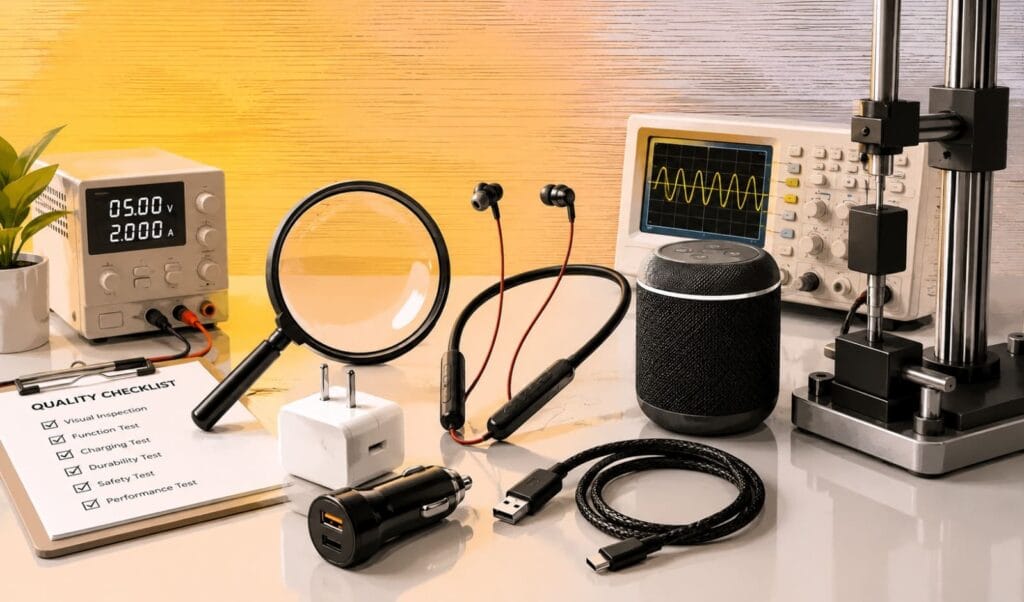
OEM Product Quality Testing Process – Quality is one of the most important factors in OEM mobile accessories manufacturing. Whether a brand is manufacturing wireless earbuds, neckbands, Bluetooth speakers, mobile chargers, charging cables, car chargers, headphones, or wired earphones, every product should go through a structured quality testing process before it reaches the market.
For retailers, distributors, e-commerce sellers, startups, and private-label brands, proper product testing helps reduce defects, improve customer satisfaction, protect brand reputation, and maintain consistent product quality.
In this guide, we explain the OEM product quality testing process for mobile accessories, from incoming material inspection to final packaging and pre-dispatch checks.
What Is Quality Testing in OEM Manufacturing?
OEM quality testing is the process of inspecting and testing products at different stages of manufacturing to verify that they meet the required specifications, performance standards, appearance requirements, and packaging guidelines.
Instead of checking products only after production is complete, an effective OEM manufacturer performs quality checks throughout the manufacturing process.
The exact testing procedure depends on the product category. For example, a mobile charger requires charging performance and electrical safety checks, while wireless earbuds require additional testing for Bluetooth connectivity, battery performance, microphones, speakers, and controls.
Why Is Quality Testing Important for Mobile Accessories?
Mobile accessories are used regularly and often depend on electrical components, batteries, connectors, cables, and wireless technology. Even a small manufacturing defect can affect the overall user experience.
A systematic quality control process can help OEM brands:
- Reduce defective products
- Maintain consistent production quality
- Verify product specifications
- Improve product reliability
- Reduce customer complaints and returns
- Maintain consistency across bulk orders
- Protect their private-label brand reputation
Quality testing becomes particularly important for bulk OEM orders because consistency is required across hundreds or thousands of units.
1. Incoming Material Inspection
Quality control begins before the final product is assembled.
Components and raw materials used for manufacturing are inspected according to the product requirements. Depending on the accessory, these may include PCB components, batteries, speaker drivers, microphones, charging connectors, cables, plastic housings, buttons, ICs, and packaging materials.
The purpose of incoming inspection is to identify unsuitable components before they enter the production process.
2. Visual and Physical Inspection
During production, products are checked for visible manufacturing defects and physical inconsistencies.
The inspection may cover:
- Product finishing
- Body alignment
- Scratches or marks
- Connector alignment
- Button placement
- Cable finishing
- Printing quality
- Logo positioning
- Product colour
- Assembly quality
For private-label manufacturing, special attention is also given to the accuracy and placement of the customer’s branding.
3. Functional Testing
Functional testing verifies whether the product performs according to its intended specifications.
Different mobile accessories require different functional tests.
Wireless Earbuds and Neckbands
Testing may include Bluetooth pairing, left and right audio output, microphone functionality, calling performance, charging, buttons or touch controls, battery operation, and connection stability.
Bluetooth Speakers
The testing process can include Bluetooth connectivity, speaker output, charging functionality, buttons, microphone functionality where applicable, and basic playback performance.
Mobile Chargers
Mobile chargers may be tested for output performance, charging functionality, port operation, compatibility, and stability under specified operating conditions.
Charging Cables
Charging cables can be checked for connector fit, charging performance, continuity, data transfer functionality where supported, and physical construction.
Car Chargers
Car charger testing may include port functionality, output performance, connector fitting, and charging stability.
These checks help identify functional defects before products proceed to final inspection.
4. Charging and Power Output Testing
Charging accessories require particular attention to power performance.
For mobile chargers, car chargers, power-related accessories, and charging cables, testing can verify whether the product delivers performance according to its defined specifications.
Depending on the product, parameters such as voltage, current, charging output, supported charging protocols, and port functionality may be checked using appropriate testing equipment.
For products with multiple ports, individual ports may also be tested separately.
5. Battery Testing
Battery-powered mobile accessories such as earbuds, neckbands, headphones, and Bluetooth speakers require battery-related checks.
Testing may cover:
- Charging functionality
- Battery operation
- Charging indicators
- Playback performance
- Standby behaviour
- Battery consistency
- Charging case functionality for TWS earbuds
Battery performance requirements should be defined according to the selected product specification and OEM configuration.
6. Audio and Microphone Testing
Audio products require additional testing because sound and calling performance directly affect the customer’s experience.
Earbuds, neckbands, speakers, headphones, and wired earphones may be checked for:
- Left/right channel operation
- Speaker output
- Sound consistency
- Microphone operation
- Calling functionality
- Unwanted noise or distortion
- Bluetooth audio connectivity
The testing criteria can vary depending on the product model and required specifications.
7. Connectivity Testing
Wireless mobile accessories generally use Bluetooth connectivity, making connection testing an important part of quality inspection.
Products can be tested for initial pairing, reconnection, connection stability, operating controls, and compatibility with suitable test devices.
This helps identify connectivity-related issues before bulk products are packed.
8. Durability and Reliability Checks
Depending on the product and agreed quality requirements, additional physical or reliability tests may be conducted.
Examples include connector insertion checks, cable bending tests, button operation tests, charging-cycle checks, and other product-specific durability evaluations.
The exact testing standards and sampling procedures should be agreed upon between the OEM manufacturer and buyer before mass production.
9. Custom Logo and Branding Inspection
For OEM and private-label orders, product performance is only one part of quality control. Branding also needs to be checked carefully.
The manufacturer should verify:
- Correct brand logo
- Logo position
- Printing clarity
- Correct product colour
- Model information
- Packaging artwork
- Barcode or labels where required
- Product and packaging consistency
This stage helps prevent branding mistakes from appearing across an entire production batch.
10. Packaging Quality Inspection
Once products pass the required functional checks, packaging is inspected.
Packaging inspection can include box quality, printing, product placement, accessories included inside the box, labels, manuals, warranty cards, and other agreed packaging components.
For private-label brands, the packaging should match the approved artwork and specifications before bulk dispatch.
11. Final Quality Inspection
After manufacturing and packaging, a final quality inspection can be performed according to the agreed inspection method or sampling plan.
The final inspection may verify product appearance, functionality, quantity, branding, packaging, model details, and other buyer requirements.
Any identified issues can then be reviewed before shipment.
12. Pre-Dispatch Verification
The final stage takes place before the order leaves the manufacturing or fulfilment facility.
The shipment may be checked for:
- Correct product model
- Required quantity
- Correct colour or variants
- Packaging condition
- Carton quantity
- Shipping labels
- Buyer-specific requirements
Once the agreed checks are completed, the bulk order can proceed for dispatch.
Quality Testing for Different OEM Mobile Accessories
Every product category requires a different quality-control approach. There is no single testing process that applies equally to every mobile accessory.
For example, wireless audio products require Bluetooth, battery, audio, and microphone testing. Charging products require electrical and output testing. Cables require connector and charging-performance checks, while mobile stands primarily require physical construction, fitting, stability, and durability checks.
Therefore, brands should define their quality requirements and product specifications before bulk manufacturing begins.
Quality Control Before Mass Production
One of the most effective ways to reduce production problems is to finalize the product specification before mass manufacturing.
The OEM process can include product selection, specification confirmation, sample evaluation, logo approval, packaging approval, production, quality inspection, and final dispatch.
Sample approval gives the buyer an opportunity to review the expected product before the bulk manufacturing stage.
Choosing an OEM Manufacturer With a Quality-Focused Process
When selecting an OEM mobile accessories manufacturer in India, buyers should evaluate more than product pricing.
Ask the manufacturer about:
- Product testing procedures
- Quality-control stages
- Sample approval process
- Branding inspection
- Packaging inspection
- Bulk production consistency
- Defect handling procedures
- Pre-dispatch inspection
Clear quality requirements between the buyer and manufacturer can significantly improve the overall OEM manufacturing process.
Conclusion
A reliable OEM product quality testing process for mobile accessories involves multiple stages rather than a single final inspection. From incoming components and production checks to functional testing, branding inspection, packaging verification, and pre-dispatch checks, every stage contributes to consistent product quality.
For businesses planning to launch or expand their own mobile accessories brand, establishing product specifications and quality requirements before mass production is essential.
Whether you are sourcing OEM earbuds, neckbands, Bluetooth speakers, mobile chargers, charging cables, car chargers, headphones, wired earphones, or other mobile accessories, working with a manufacturer that follows a structured quality-control process can help create more consistent and reliable products for your brand.
Planning Your Own Mobile Accessories Brand
Get an OEM manufacturing quote based on your product, quantity, specifications, branding and packaging requirements.Discuss your requirements for earbuds, neckbands, Bluetooth speakers, chargers, cables, headphones, car chargers and mobile stands.